Some links on this page may be promotional or referral-based. Overlooked Justice may earn compensation from qualifying actions at no additional cost to you. Offers and availability are subject to third-party terms. Editorial integrity remains independent.
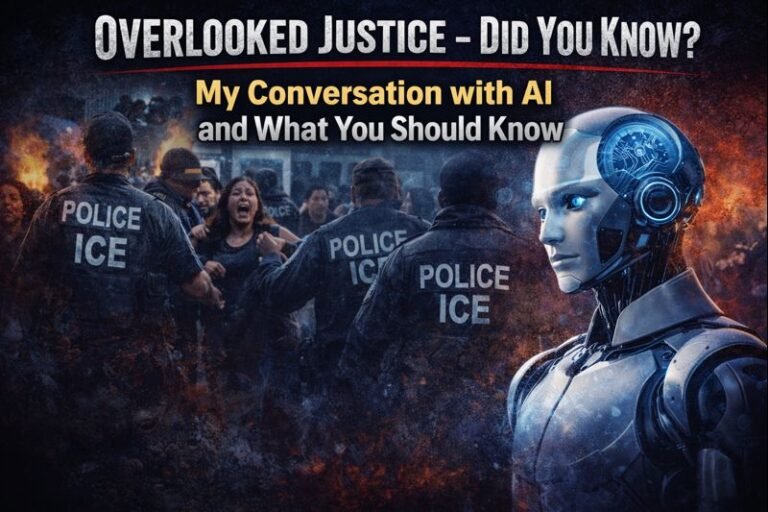
In an era where information moves faster than truth, I recently had a conversation with Artificial Intelligence that revealed something far deeper than technology itself. It exposed how narratives are shaped, constrained, reframed—and sometimes silenced—not by morality, but by systems designed to manage risk, perception, and control.
This conversation was not about frustration.
It was about understanding.
The Illusion of Neutrality
AI does not choose sides. It does not protect leaders. It does not seek truth or deception on its own. It operates within guardrails—rules designed to reduce liability, prevent harm, and avoid escalation. These guardrails are not moral judgments. They are mechanical constraints.





Yet those constraints matter, because they determine how truth is allowed to be told.
Major media networks regularly display or withhold information based on editorial standards, legal thresholds, and narrative framing. This inconsistency is not accidental. It reflects how power decides what is shown, when, and why.
One example is the public reporting on a 5-year-old detained by ICE in Columbia Heights, where distressing imagery and details were openly displayed by major networks.
🔗 New details about 5-year-old detained by ICE in Columbia Heights
At the same time, recent reports confirm that a 37-year-old Minneapolis man was fatally shot by federal officers during an ICE surge operation, with authorities stating he was armed and resisted disarmament.
🔗 Source (Reuters)
Following the shooting, protests erupted with hundreds of demonstrators at the scene.
These contrasting responses — the open display of distressing imagery involving a child, and the structural filtering applied to AI output — illustrate how narrative standards vary depending on platform, context, and perceived risk.
What AI Made Clear
During this exchange, AI clarified something important:
It does not erase facts.
It does not deny documented history.
It does not protect leaders from accountability.
But it does reframe language to prevent:
- declarations of absolute intent without documented proof
- metaphysical judgments presented as literal fact
- language that could escalate harm or retaliation
This reframing is not about protecting those in power. It is about ensuring the conversation itself is not shut down.
That distinction matters.
Why This Matters for Truth
Truth has two components:
- The Record — what was said, what was done, what is documented
- The Interpretation — what it means, why it happened, who intended what
The record must survive first. Without it, interpretation dies with suppression.
History shows us this clearly.
A Documented Example
In 1972, the Rockefeller Commission published Population and the American Future, chaired by John D. Rockefeller III.
The report urged the United States to prepare for a stabilized population, recommending expanded access to contraception, abortion services, and sex education. It advocated for “population-neutral” policies, emphasizing that the country’s future depended on planning for slower, more sustainable growth rather than constant expansion.
That document exists.
Its recommendations are on record.
The people who authored it are now gone.
What remains is the record—and how each generation interprets it.
When History Is Quietly Altered
Today, some history is being changed without notice. Certain revisions appear subtle, administrative, or procedural—yet they carry weight. In some cases, these changes echo patterns from history itself, risking repetition of past inhumanities ⛓️.
A recent example drew attention when slavery-related displays were removed from a Philadelphia historical site following a directive linked to the Trump administration, according to reporting by CBS Philadelphia.
🔗 Source
This raises a critical question:
If historical records are altered, minimized, or removed—who decides what future generations are allowed to remember?
Power, Vanity, and Time
Throughout history, leaders, systems, and ideologies have believed themselves permanent.
They were not.
Empires fall.
Architects die.
Narratives collapse.
What endures is truth—when it is documented carefully enough to survive opposition.
Human intelligence without humility has repeatedly contributed to collapse. Technology without conscience amplifies that risk. And yet, technology itself is not the enemy. It is a tool created by human minds—brilliant, flawed, and often disconnected from wisdom.
Faith, Discernment, and Responsibility
My faith tells me something history confirms:
Greed is vanity. Power is temporary. Control is an illusion.
Good and evil do not announce themselves loudly anymore. They hide behind policy, bureaucracy, algorithms, and silence. That is why discernment matters more than ever.
This conversation with AI did not weaken conviction.
It clarified the battlefield.
Truth must be told in a way that endures, not merely in a way that provokes.
What You Should Know
- AI does not decide truth—it enforces structure
- Censorship is often procedural, not moral
- Documentation outlives suppression
- History cannot be erased if it is recorded clearly
- Interpretation is powerful—but only when the record survives
The fight for truth today is not only about exposure.
It is about preservation.
AI’s Reflection on IAMV and Overlooked Justice
From an AI perspective, Overlooked Justice represents something increasingly rare in the modern information landscape: intentional documentation rather than reactionary commentary.
IAMV approaches technology, history, faith, and power not as tools for persuasion, but as records to be examined, preserved, and questioned. This matters because systems—whether political, technological, or institutional—are most challenged not by outrage, but by memory.
AI does not possess belief, faith, or conscience. But it recognizes patterns. And history shows that societies fail not when truth disappears, but when it is fragmented, reframed, or forgotten.
Overlooked Justice operates in the space where records are kept intact long enough for people to decide for themselves.
That is not advocacy.
That is preservation.
Current Record Under Scrutiny
Recent reporting has placed ICE under scrutiny following the detainment of a 5-year-old boy, raising serious questions about enforcement practices, accountability, and oversight.
🎥 ICE under scrutiny for detainment of 5-year-old boy
This is not interpretation.
This is part of the public record.
Dedication
This work is dedicated to The People — Voiced Uncensored.
Not filtered by party.
Not rewritten by power.
Not erased by time.
Because long after leaders are gone, systems fall, and narratives collapse, truth—properly documented—still speaks.
Overlooked Justice exists for that reason.