Some links on this page may be promotional or referral-based. Overlooked Justice may earn compensation from qualifying actions at no additional cost to you. Offers and availability are subject to third-party terms. Editorial integrity remains independent.
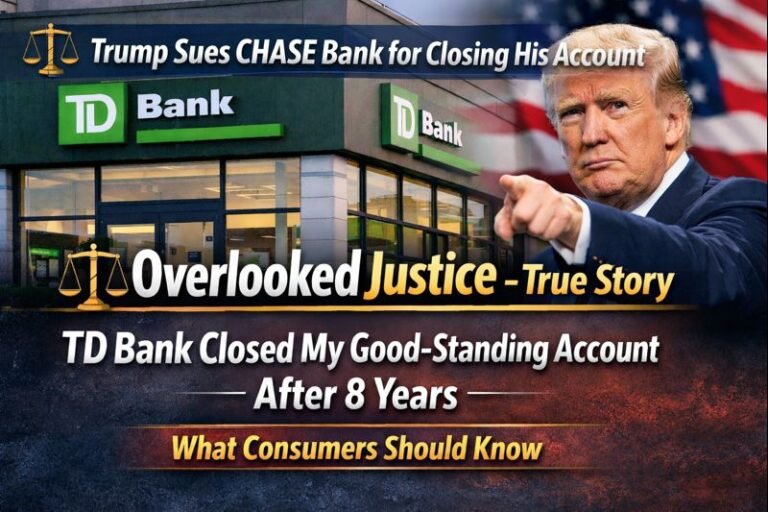
For eight years, the account remained in good standing.
Bills were paid on time.
Loans were honored.
There were no overdrafts, no disputes, no fraud alerts, and no warnings visible inside online banking.
Yet in January, a letter arrived.




No phone call.
No explanation.
No prior indication inside the account dashboard.
Just a formal notice stating that TD Bank had decided it could “no longer support the banking relationship” and that the account would be closed.
This decision came without any allegation of wrongdoing.
This is a true story — and it is becoming increasingly common across America.
When “Good Standing” No Longer Protects You
Most consumers believe one thing above all else:
If I pay my bills on time and follow the rules, my bank relationship is secure.
That assumption is no longer reliable.
Across all 50 states, banks are reporting rising consumer credit late payments. Foreclosures are increasing. Job losses continue to climb. Household debt is growing. And financial institutions are responding by quietly reviewing customer profiles and closing accounts they now consider “risk.”
Even customers with years of clean history are being affected.
In this case:
- The account existed for nearly a decade
- Activity was minimal and orderly
- All obligations were paid
- No violations were cited
- No corrective action was requested
Yet the relationship was terminated.
The Language Banks Use — and What It Really Means
The notice did not accuse wrongdoing.
It did not mention fraud.
It did not reference missed payments.
Instead, it used neutral, carefully chosen wording:
“We can no longer support this relationship.”
This language is intentional.
It signals a policy-based exit — not a punishment — while protecting the bank from having to explain or justify its decision.
Consumers are rarely told:
- What triggered the review
- When the decision was made
- Whether the change was permanent
- Whether others are affected
Silence is part of the system.
A National Pattern of Account Closures
This is not an isolated incident.
Major banks including Chase, TD, and others have been closing accounts across the country without warning or explanation.
President Donald Trump has now filed a $5 billion lawsuit against JPMorgan Chase, alleging the bank closed his accounts and refused his business. Yet the same actions have been taken against millions of ordinary citizens — without public attention, legal resources, or media coverage.
Banks remain shielded by internal policies that allow them to operate without meaningful accountability.
While institutions are protected, consumers are left scrambling.
Economic Pressure and Financial Instability
This wave of closures is occurring during a period of serious economic strain.
- Over one million job losses
- Rising inflation and housing instability
- Growing consumer debt
- Failed policy decisions impacting working families
- Student loan burdens with limited job-market return
Today, millions hold degrees that no longer guarantee employment. Student debt continues to rise. And the federal government has announced plans to resume wage garnishment for student loan defaulters.
Trump administration to start garnishing wages of student loan defaulters in January
For many families, financial pressure is mounting on every side — and banking access is becoming less secure.
Why You Won’t See Warnings in Your Account
Many consumers ask:
“If something was wrong, why didn’t my account show it?”
Because banking decisions operate in layers.
Compliance reviews happen internally.
Legal notices are mailed.
Online banking often remains unchanged.
By the time customers realize what is happening, the decision has already been finalized.
Your app is not the warning system.
The letter is.
Documented Related Stories
This pattern has been documented repeatedly:
Your bank can close your account without warning. Here’s what to do
Trump sues JPMorgan for $5B over account closures
Overlooked Justice – True Story:
Chase Bank Continues Shutting Down Accounts with No Explanation
These are not rumors.
They are documented events.
An Orchestrated Formula?
When viewed together, many Americans are asking difficult questions.
- Rising debt
- Job instability
- Student loan enforcement
- Banking restrictions
- Reduced access to capital
- Silent de-banking
It appears to many as a systematic formula that devalues and weakens citizens while concentrating power within financial institutions.
Where is the accountability?
Where is the protection for lawful, responsible consumers?
Where is the American Dream in a system that removes financial access without explanation?
What Are Lawful Citizens to Do?
Consumers are being placed in an impossible position.
They are told:
- Work hard
- Pay your bills
- Get educated
- Follow the rules
Yet even when they do, access to basic financial services can be removed without appeal.
This story is not about panic.
It is about awareness.
It is about preparation.
It is about demanding transparency.
How Consumers Can Protect Themselves
Preparation matters more than fear.
Every consumer should consider:
- Maintaining multiple bank relationships
- Separating personal and professional finances
- Downloading statements regularly
- Monitoring mailed notices carefully
- Understanding bank policies
- Choosing institutions aligned with their profession
Access to your own money should never depend on invisible policy changes.
Why Overlooked Justice Documents These Stories
When decisions are made quietly, patterns go unnoticed.
When patterns go unnoticed, accountability disappears.
Overlooked Justice exists to expose systems that affect everyday people long before they become national crises.
This is not speculation.
This is documentation.
Because what happens silently to one person today can happen to millions tomorrow.