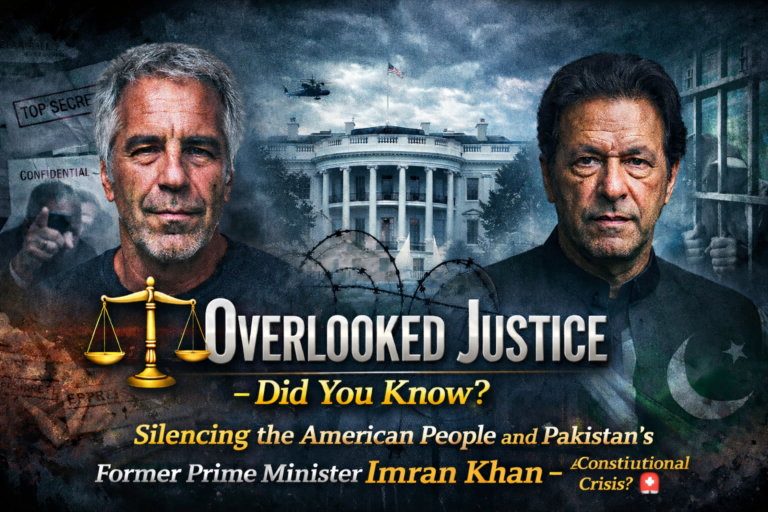
Imran Khan, the Epstein Files Allegations, and the Growing Debate Over Free Speech and Political Targeting
Across the globe, many are asking a difficult question: Are governments programming public perception while silencing independent thought?
From America to Pakistan, narratives appear to shift daily — dividing people, creating fear, and redirecting attention away from the actions of those in power. As voices grow louder online, so do accusations of censorship, political targeting, and the erosion of constitutional protections.
There are increasing concerns that leaders craft narratives designed to condition populations — encouraging citizens not to trust their own eyes or independent judgment. When stories change overnight, when institutions contradict themselves, and when dissenting voices are labeled threats, the question becomes unavoidable:
Is this governance — or narrative control?
A Pattern of Shifting Narratives
History has shown how powerful narratives can shape global perception:
- The push for universal compliance during COVID-19 — followed by legal battles and shifting public health messaging.
- The claims that Saddam Hussein possessed weapons of mass destruction — later revealed to be unsubstantiated after war and death had already occurred.
- Ongoing debates about education systems, historical narratives, and what parts of history are emphasized — or erased.
When history is rewritten or selectively taught, future generations may only know what they are programmed to know.
As IAMV states:
“The intelligence of our leaders is the stupidity that has contributed gravely to our fallen world.”
Pakistan: The Case of Imran Khan
Former Pakistani Prime Minister Imran Khan was arrested inside the Islamabad High Court by Pakistan’s National Accountability Bureau (NAB) in connection with the Al-Qadir Trust case — charges he and his supporters maintain are politically motivated.
Supporters argue:
- He was labeled a “threat to peace.”
- His political movement was suppressed.
- Digital restrictions and content blocking have limited public discourse.
- Firewall systems have allegedly been used to restrict messaging critical of current leadership.
Imran Khan remains one of Pakistan’s most popular political figures among broad segments of the population. His detention has sparked both domestic unrest and international debate.
Epstein’s Emails and the “Threat to Peace” Claim
According to recently documented reporting, emails from convicted sex offender Jeffrey Epstein — released by the U.S. House Oversight Committee — included a controversial 2018 exchange in which Epstein described Imran Khan as a “significant threat to peace,” suggesting he was a “much greater threat to peace” than leaders such as Vladimir Putin, Xi Jinping, and Recep Tayyip Erdogan.
These emails, dated July 31, 2018, emerged from a larger batch of correspondence disclosing Epstein’s views on global political figures shortly after Khan’s Pakistan Tehreek-e-Insaf (PTI) party won a historic election.
Importantly, reporting on the emails also noted that independent fact-checking found no verified evidence connecting Khan to the Epstein criminal network, separate from the documented email exchange.
The Voices of the People in Pakistan
Supporters worldwide continue to rally:
🔗 Free Imran Khan – Free Pakistan
#pakistan #afghanistan #imrankhan #southasia #pashtun
To many, this is not simply about one leader.
It is about sovereignty, transparency, and the right of people to freely express dissent against governance they perceive as unjust.
America: A Constitutional Tension?
In the United States, many citizens express concern about:
- Narrowing boundaries of acceptable speech.
- Economic inequality and political polarization.
- Immigration rhetoric used to divide communities.
- The rising power of digital platforms to amplify or suppress narratives.
Is constitutional protection of speech and dissent being eroded?
Or is the current moment simply a chaotic byproduct of information overload?
Either way, polarization accelerates when public trust declines.
A Global Crossroads
Whether in Washington or Islamabad, a larger pattern appears to concern millions:
When leaders define who is a “threat to peace,”
who determines what peace actually means?
When narratives shift rapidly,
how does a population discern truth from strategy?
Final Reflection
There is only one path that prevents collapse:
Not hate.
Not blind loyalty.
Not division.
But discernment.
Wisdom.
Accountability.
Govern your own lives.
Use wisdom and knowledge to discern.
God bless you all.
Overlooked Justice – The People’s Voice Uncensored