Who Is Protecting Epstein’s Circle? Transparency, Power & Political Deflection in America?
The rule of law speaks often about protecting children, yet many citizens have discovered that lesser-known statutes once existed that allowed minors as young as 14 to legally marry in certain circumstances.
These realities have led some citizens to question how laws intended to protect the vulnerable can also contain provisions that critics argue may enable exploitation or shield wrongdoing. They raise broader concerns about transparency, accountability, and how the legal system applies justice.
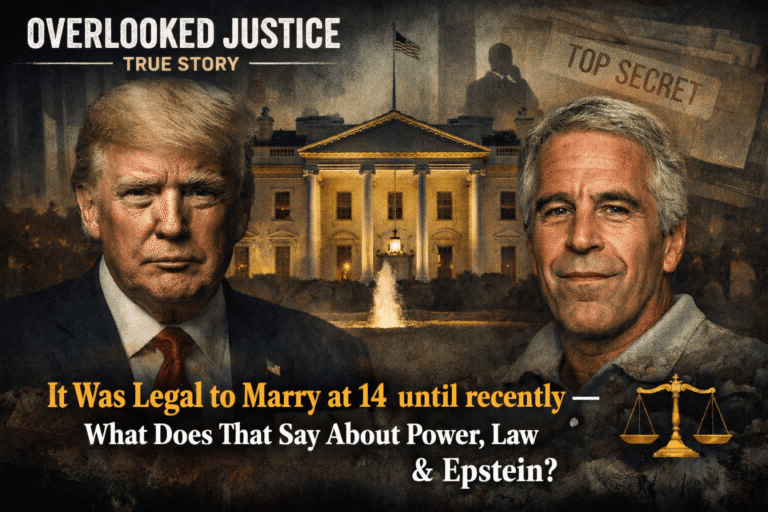
Before North Carolina Senate Bill 35 took effect on August 26, 2021, North Carolina law allowed minors as young as 14 years old to legally marry in cases involving pregnancy — with court approval.
At that time:
- 16–17-year-olds could marry with parental consent
- 14–15-year-olds could marry if a judge approved and pregnancy or childbirth was involved
For many citizens, this raised serious concerns about vulnerability, coercion, and legal loopholes that most families were unaware even existed. It led some to question how laws intended to protect children could, in practice, contain provisions that critics argue may have enabled exploitation or shielded individuals who committed crimes against minors.
Today, the law has changed.
Under SB 35, the minimum marriage age in North Carolina is now 16, with added age-gap restrictions and stronger safeguards intended to reduce exploitation.
⚠️ NOTE: Do your own research (and save sources) 🧾🧠
Links that were once easy to find can change, move, or break over time. Use wisdom and discernment, and verify from official sources when possible.
📜 Current NC Marriage Law (Chapter 51) – Research for Yourself
📄 Session Law 2021-138 (SB 35 – Effective August 26, 2021) – Research for Yourself
🧠 Transparency Beyond One State
While North Carolina reformed its statute, broader public debate continues regarding transparency and accountability in cases involving powerful individuals — including Jeffrey Epstein and the network connected to his crimes.
This parable raises a civic question:
🧩 If laws like this existed quietly for years — who benefits from legal gray areas, secrecy, and selective accountability?
For some Americans, laws that once allowed early marriage raise uncomfortable questions:
- Why did such statutes remain in place for so long?
- Who benefits from legal gray areas?
- Are outdated or obscure laws sometimes exploited?
- Has justice been applied equally at every level of power?
Public discussion continues regarding:
- 📂 The release of investigative records
- 📁 Sealed court documents
- ⚖️ Accountability for influential figures
- 🏛️ Whether equal enforcement truly exists
Across political lines, citizens are calling for:
✔️ Full transparency
✔️ Equal application of the law
✔️ Protection of minors
✔️ Preservation of constitutional liberties
Some argue the rule of law feels strained and in need of reform — including stronger safeguards, greater oversight, and structural changes such as term limits to reduce entrenched power.
Regardless of viewpoint, one principle remains central:
The rule of law must apply equally — regardless of status, power, or position.
When laws change quietly, citizens deserve to understand why.
When investigations involve influence and wealth, transparency becomes even more critical.
Wisdom requires discernment.
Knowledge demands awareness.