Some links on this page may be promotional or referral-based. Overlooked Justice may earn compensation from qualifying actions at no additional cost to you. Offers and availability are subject to third-party terms. Editorial integrity remains independent.
Voting Rights • Government Accountability • Humanity vs AI
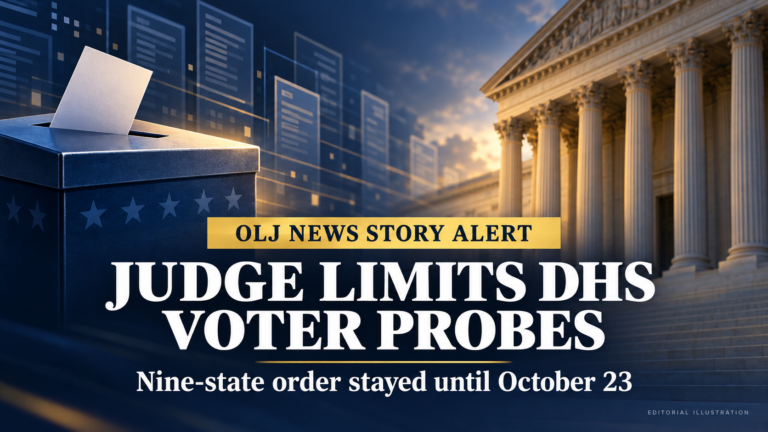
A federal judge has limited certain Department of Homeland Security voter investigations in nine states, placing government data accuracy and the protection of eligible citizens at the center of an election-season legal battle.
U.S. District Judge Araceli Martínez-Olguín issued the preliminary injunction on October 21 in California Nurses Association v. Mullin, No. 4:26-cv-10680, in the Northern District of California.





The restrictions cover specified election-related field operations involving people officials know, suspect or reasonably should suspect are U.S. citizens. The affected states are California, Connecticut, Georgia, Missouri, Nevada, New York, Pennsylvania, Washington and Wisconsin.
What the ruling does—and when it takes effect
The order is stayed until 5 p.m. Friday, October 23. Its restrictions are scheduled to continue through the close of polling on November 3, unless changed by the court.
The judge required a $100 bond by 5 p.m. October 22, with dissolution of the order if it was not posted. Bond compliance and subsequent appellate action were not verified in the records reviewed.
This is a preliminary injunction, not a final judgment, and it does not prohibit every voter-fraud investigation.
Why the plaintiffs challenged the investigations
The plaintiffs include the California Nurses Association, National Nurses United, Voto Latino Foundation, Santa Clara County, and the City and County of San Francisco.
Their challenge alleges that federal agents’ visits to homes to question voting eligibility could intimidate citizens, particularly when investigative lists contain inaccurate matches. Plaintiffs’ counsel identified naturalized citizens and citizens in mixed-status households among those vulnerable to mistakes.
Those are the plaintiffs’ allegations and concerns. They should not be treated as proof that every investigation targeted an eligible voter.
DHS’s position
DHS told The Associated Press that it targets unlawful voting by noncitizens and has no plans to question or investigate people it believes are U.S. citizens.
IAMV perspective: A database flag should not become a verdict
Protecting election integrity requires accurate information and accountable enforcement. It also requires protecting eligible citizens from mistakes that discourage lawful participation.
OLJ’s concern is practical: How does someone correct a government record before an inaccurate match produces an investigative visit? Who checks the information, documents the error and ensures that the same mistake does not happen again?
These are accountability questions, not findings about any particular agent’s intentions.
What voters should know
The ruling does not change anyone’s registration or establish an individual’s eligibility. Verify registration, voting locations and deadlines through your state or local election office.
Anyone documenting a disputed encounter should preserve relevant correspondence and record the date, agency and circumstances accurately. Avoid publicly sharing sensitive identification documents.
Questions still requiring answers
The public needs clearer information about error rates, review procedures and how affected people can challenge inaccurate records. OLJ will distinguish documented experiences from unverified accounts and track further court action.
Reviewed sources and supporting records
Court order:
Independent reporting:
Associated Press reporting and DHS response:
https://apnews.com/article/ac8a87b135f7a2ae9fe961bab3b28825
Case history:
https://clearinghouse.net/case/48482/
Plaintiffs’ counsel’s announcement and linked complaint: