
Some links on this page may be promotional or referral-based. Overlooked Justice may earn compensation from qualifying actions at no additional cost to you. Offers and availability are subject to third-party terms. Editorial integrity remains independent.
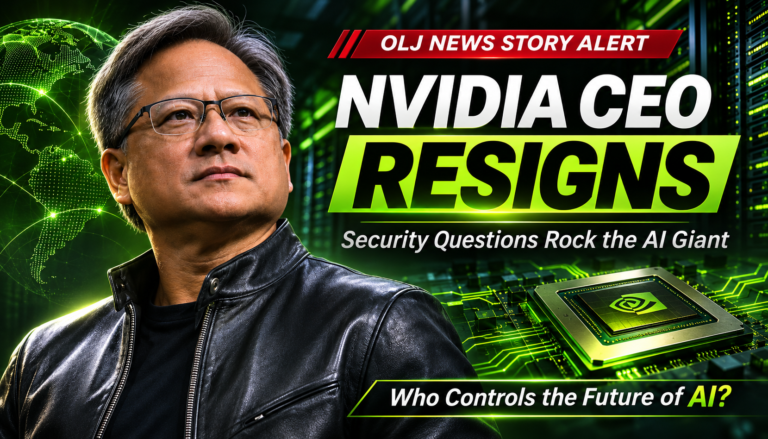
NVIDIA’S LONGTIME LEADER IS OUT — AS QUESTIONS SWIRL ABOUT NATIONAL SECURITY, CORPORATE POWER, AND THE FUTURE OF ARTIFICIAL INTELLIGENCE.
The People’s Voice Uncensored!
THE SHOCKING DEPARTURE OF NVIDIA’S LONGTIME LEADER
On November 12, 2026, NVIDIA confirmed that Jensen Huang, the executive who helped turn the company into a cornerstone of the artificial-intelligence boom, had resigned as president, chief executive officer and a board member. The company appointed longtime finance chief Colette Kress as interim CEO, with Harvey C. Jones becoming its first board chair. NVIDIA’s official announcement confirms the leadership changes.





For more than three decades, Huang’s identity was closely tied to NVIDIA. The transition now raises significant questions about governance, continuity and the stewardship of technology used across the global AI economy.
THIS IS MORE THAN A CORPORATE SUCCESSION STORY. WHEN A COMPANY HELPS PROVIDE THE COMPUTING POWER BEHIND A NEW TECHNOLOGICAL ERA, WHO HOLDS ITS LEADERS ACCOUNTABLE?
WHAT THE OFFICIAL RECORDS SHOW
According to the company’s Form 8-K filed with the U.S. Securities and Exchange Commission, NVIDIA’s board accepted Huang’s resignation on November 11, effective immediately. The public announcement followed on November 12.
Kress will continue as chief financial officer while serving as interim CEO. The board has begun a search involving internal and external candidates for a permanent successor. Jones, who has long served on NVIDIA’s board, will lead the board as chair.
The company says it expects operations, its product roadmap and customer commitments to continue. That is NVIDIA’s stated expectation—not a guarantee of how every future challenge will unfold.
THE SECURITY CONTROVERSY — ALLEGATIONS ARE NOT PROOF
Huang’s exit followed media reports about personal relationships, including an alleged relationship involving a woman U.S. intelligence officials reportedly suspect of ties to Chinese espionage. Associated Press and Reuters have reported on the controversy and related national-security concerns.
Huang publicly acknowledged marital infidelity and apologized. Chinese authorities have denied the espionage allegations. NVIDIA has said it has no reason to believe that company secrets or national-security information were compromised.
THE DISTINCTION MATTERS: A REPORTED SUSPICION IS NOT A VERIFIED ESPIONAGE FINDING. A PERSONAL RELATIONSHIP DOES NOT, ON ITS OWN, ESTABLISH THAT SECRET INFORMATION WAS SHARED.
Public reporting also describes a board-initiated investigation. Its eventual findings, rather than speculation, should determine what conclusions can responsibly be reached.
WHAT DID THE BOARD KNOW — AND WHEN?
The controversy puts corporate oversight under a spotlight. What security warnings did the board receive? How were possible conflicts of interest assessed? Were internal reporting systems adequate? And can an independent inquiry address concerns while preserving due process?
These questions are important precisely because the allegations remain contested or unresolved. An effective investigation should separate documented facts, credible testimony, uncertainty and claims that cannot be substantiated.
PUBLIC TRUST CANNOT REST ON RUMOR — BUT NEITHER SHOULD POWERFUL INSTITUTIONS BE EXEMPT FROM SCRUTINY.
THE CHINA CHIP DEBATE AND NATIONAL SECURITY
NVIDIA’s advanced chips have become central to debate over U.S. export controls and access to AI computing. American officials have argued for restrictions on certain high-end chips because of their potential military and intelligence applications. Industry participants have warned that broad restrictions may also harm legitimate business and encourage competitors to build alternatives.
The resignation and reported security controversy have intensified attention on the relationships between corporate leaders, policymakers and cross-border technology businesses. Reuters’ chronology provides background on the policy and business questions.
WHO MAKES DECISIONS ABOUT ACCESS TO THE MOST POWERFUL AI TECHNOLOGY — AND HOW CAN THE PUBLIC ASSESS THOSE DECISIONS?
COLETTE KRESS TAKES OVER AT A CRITICAL MOMENT
Colette Kress joined NVIDIA in September 2013 and helped oversee its finances during years of dramatic growth. Reuters reported on November 13 that Kress had sometimes challenged ambitious spending and financing proposals, portraying her as a pragmatic counterweight to Huang’s expansive vision.
As interim chief executive, she faces the challenge of reassuring employees, investors, suppliers and customers while a search for permanent leadership proceeds. NVIDIA’s next earnings report, scheduled for November 17, 2026, is an opportunity for the company to communicate more about its financial outlook and operational priorities.
The company’s technical expertise extends beyond any one executive, but a transition after more than three decades raises reasonable questions about succession planning and institutional resilience.
WHY THE WORLD SHOULD PAY ATTENTION
NVIDIA hardware and software support artificial-intelligence development, data centers, scientific research and many emerging industrial applications. Disruption at a major supplier can affect planning throughout the ecosystem, even if the underlying products and engineering teams remain intact.
There is also a wider issue: AI infrastructure, capital and specialized expertise are concentrated among relatively few businesses. That concentration can accelerate innovation, but it makes governance and accountability particularly important.
Companies are accountable to shareholders and customers. Governments are responsible for protecting legitimate national-security interests. Ordinary people also deserve transparency about decisions shaping technology that could influence employment, education, healthcare and access to information.
WHAT INVESTIGATORS — AND READERS — SHOULD ASK
1. WHAT EVIDENCE SUPPORTS THE SECURITY ALLEGATIONS?
Reports about suspected intelligence activity should be assessed by competent investigators and should not be presented as established facts without proof.
2. DID NVIDIA’S GOVERNANCE SYSTEMS WORK?
The board’s handling of concerns, conflicts of interest and executive oversight deserves independent evaluation.
3. HOW PREPARED IS THE COMPANY FOR LEADERSHIP CHANGE?
Customers and employees need continuity, not just reassuring statements.
4. WHO OVERSEES THE AI INFRASTRUCTURE ON WHICH SO MUCH NOW DEPENDS?
Greater technological influence increases the importance of transparent, responsible decision-making.
THE OVERLOOKED JUSTICE PERSPECTIVE — WHO CONTROLS OUR FUTURE?
The resignation of NVIDIA’s longtime leader marks an extraordinary moment in the AI industry’s history. The documented leadership change is significant; the allegations surrounding it deserve rigorous examination, not premature conclusions.
Artificial intelligence offers enormous opportunities, but its development must be matched by safeguards that protect the public, respect evidence and demand accountability from powerful decision-makers.
WHO CONTROLS THE TECHNOLOGY SHAPING HUMANITY’S FUTURE? WHO PROTECTS THE PUBLIC WHEN CORPORATE INTERESTS AND NATIONAL SECURITY INTERSECT? AND WHO HOLDS THE MOST POWERFUL LEADERS ACCOUNTABLE?
The answers matter far beyond NVIDIA.
OVERLOOKED JUSTICE — THE PEOPLE’S VOICE UNCENSORED!
SOURCES AND FURTHER READING
NVIDIA — Official CEO Transition Announcement (November 12, 2026)
Associated Press — What We Know After Jensen Huang Resigns
Reuters — How Huang Became Entangled in China Chip and Spy Controversy