Some links on this page may be promotional or referral-based. Overlooked Justice may earn compensation from qualifying actions at no additional cost to you. Offers and availability are subject to third-party terms. Editorial integrity remains independent.
 DID YOU KNOW?
A woman’s body can begin changing years before menopause — and for many women, those changes can arrive before they fully understand what is happening.
You may not sleep like you used to.
Your period suddenly changes.





Your mood feels different.
Your energy isn’t the same.
Your body begins responding differently to food, exercise, stress, intimacy and everyday life.
And somewhere in the middle of everything else a woman may be carrying — career, children, marriage, relationships, aging parents, finances and responsibilities — she may quietly ask:
“What is happening to me?”
Or perhaps the bigger question:
“Why didn’t anyone prepare me for this?”
The answer could be something millions of women experience.
IT COULD BE PERIMENOPAUSE
Perimenopause is the transition leading up to menopause.
During this period, hormone levels can fluctuate and women may begin noticing physical and emotional changes months or even years before their final menstrual period.
It most commonly begins during a woman’s 40s, although some women can experience changes earlier.
Menopause is reached after 12 consecutive months without a menstrual period, when there is no other medical explanation.
But there is something every woman should know:
There isn’t one universal perimenopause experience.
Every woman’s body is different. Every woman’s symptoms can be different. And every woman’s journey can be different.
SOME OF THE CHANGES WOMEN MAY EXPERIENCE
Perimenopause isn’t simply about periods eventually stopping.
Women may experience:
- Hot flashes and night sweats
- Trouble falling asleep or staying asleep
- Irregular, heavier, lighter, longer or shorter periods
- Mood changes, anxiety or irritability
- Difficulty concentrating or feeling mentally “foggy”
- Changes in weight or body composition
- Changes in sexual desire
- Vaginal dryness or discomfort during sex
- Urinary changes
- Changes in bone health
- Changes affecting cardiovascular health
- Emotional changes that may leave a woman wondering why she doesn’t feel like herself
Not every woman experiences the same symptoms, and their intensity can differ considerably.
But when your body starts changing and nobody has explained why, it can feel deeply personal.
Why am I exhausted after sleeping?
Why am I suddenly awake at 3 a.m.?
Why do my emotions seem stronger?
Why does my confidence feel different?
Why does the body I’ve known for decades suddenly feel unfamiliar?
Sometimes women suffer quietly because they believe they’re simply supposed to deal with it.
You don’t have to suffer in silence.
 THE MENTAL-HEALTH CONVERSATION MATTERS TOO
The physical symptoms of perimenopause often receive the most attention, but the emotional and mental-health conversation deserves attention as well.
Changes in hormones, disrupted sleep, stress and the realities of midlife can overlap at the same time.
For a woman already balancing a career, family, relationships, aging parents, finances and other responsibilities, those changes can become overwhelming.
 RELATED VIDEO
Menopause: The Silent Killer of Women’s Mental Health
If you’re experiencing significant anxiety, depression, persistent mood changes or other concerning symptoms, speaking with a qualified healthcare professional is important.
Your mental health matters too.
 FEATURED BUSINESS | ASSURANCE PLANS AI
Life changes. Being informed before you need protection matters.
Assurance Plans AI helps individuals and families learn about insurance options, ask questions and connect with licensed insurance professionals when they’re ready to explore coverage.
Education today. Protection tomorrow.

Featured Business presentation. Assurance Plans AI is separate from the editorial content of this Overlooked Justice story.
THIS ISN’T ONLY A CONVERSATION FOR WOMEN
Perimenopause can affect much more than a woman’s menstrual cycle.
When sleep, mood, energy, intimacy and emotional well-being change, the people closest to her may notice those changes too.
That is why husbands, partners and men who care about the women in their lives can benefit from understanding what perimenopause is.
Instead of asking:
“What’s wrong with her?”
Perhaps we should begin asking:
“What is she experiencing — and how can I support her?”
RELATED VIDEO
Why Men Should Understand Perimenopause
Understanding can create compassion.
And compassion can change relationships.
WOMEN NEED TO TALK ABOUT IT
There is something powerful about another woman saying:
“I went through that too.”
Not because every woman’s journey is identical, but because sometimes knowing you’re not the only woman asking these questions can make the journey feel less isolating.
And that conversation shouldn’t stop with perimenopause.
Women experience physical, emotional and personal transitions throughout their lives.
3 WOMEN’S CHANGES WE NEED TO TALK ABOUT
1. Hormonal and Menstrual Changes
Periods may become unpredictable during perimenopause.
Some women experience changes in frequency, flow and duration while also noticing differences in sleep, mood or energy.
Understanding what may be happening gives women an opportunity to ask questions and seek professional guidance when appropriate.
2. Menopause and the Body Afterward
The transition can involve much more than hot flashes.
Women’s bone health, cardiovascular health, sleep, sexual health, body composition and overall wellness deserve continued attention during and after menopause.
Growing older shouldn’t mean women stop asking questions about their bodies.
It should mean we start having better conversations about them.
3. Mental and Emotional Wellness
Women may simultaneously be navigating hormonal changes, careers, relationships, children leaving home, aging parents, financial responsibilities and questions about their own future.
Sometimes the woman who has spent decades caring for everyone else suddenly realizes:
She needs someone to care about what she’s going through too.
MAYBE THE CONVERSATION IS BIGGER THAN PERIMENOPAUSE
Maybe women need somewhere they can discuss all of it.
Their bodies.
Their health.
Their marriages and relationships.
Children and grandchildren.
Getting older.
Anxiety and emotional wellness.
Faith.
Love.
Self-care.
Purpose.
Starting over.
And those deeply personal questions that aren’t necessarily meant for the entire internet.
That is where TJ Ferrell comes in.
 JOIN TJ FERRELL — A PRIVATE PLACE FOR WOMEN
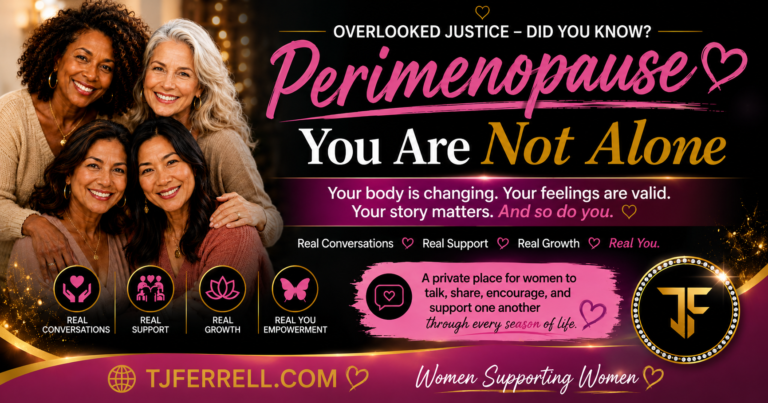
Join TJFerrell.com — A Private Place for Women was created to give women a community where they can talk, learn, share, encourage, inspire and support one another through the different seasons of womanhood.
Because sometimes the person who understands what you’re experiencing isn’t someone with millions of followers.
It’s another woman who has already lived it.
A woman who can say:
“I understand.”
“I’ve experienced changes too.”
“You’re not alone.”
“Keep going.”
“There is still so much life ahead of you.”
God is good through every season.
And perhaps one of the greatest gifts women can give one another is the willingness to share what they learned along the way.
 OVERLOOKED JUSTICE ASKS WOMEN:
What is ONE thing you wish another woman had told you about perimenopause, menopause, aging, relationships, health — or simply becoming an older and wiser woman?
Maybe it’s something you wish your mother had told you.
Maybe it’s something you learned through experience.
Maybe it’s something you would tell your daughter today.
Or maybe it’s something another woman needs to hear right now.
Your experience may be exactly what another woman needs to hear today.
 Share your voice. Join the conversation. Support another woman.
Continue the conversation at TJFerrell.com — A Private Place for Women.
 HEALTH & WELLNESS NOTICE
Health information in this story is provided for general education and awareness and is not a substitute for individualized medical advice, diagnosis or treatment.
Women experiencing new, severe, persistent or concerning physical or mental-health symptoms should speak with a qualified healthcare professional.
OVERLOOKED JUSTICE
The People’s Voice. Uncensored.
Awareness • Protection • Empowerment
 Share this story with a woman who may need to hear: “You are not alone.”