Some links on this page may be promotional or referral-based. Overlooked Justice may earn compensation from qualifying actions at no additional cost to you. Offers and availability are subject to third-party terms. Editorial integrity remains independent.
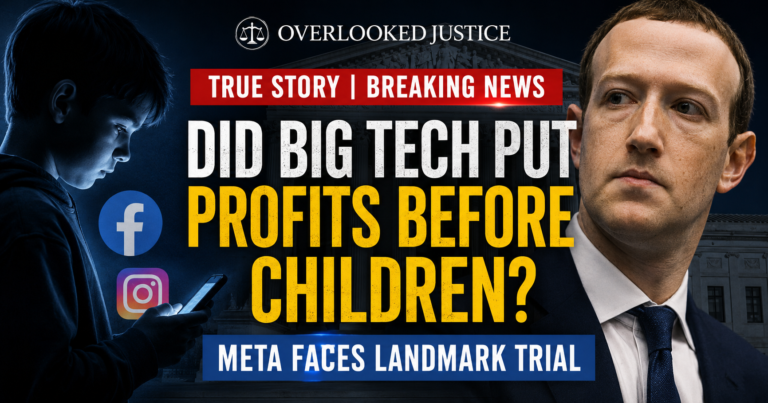
One of the world’s most powerful technology companies is facing a landmark federal trial over how Facebook and Instagram allegedly treated children.
Meta Platforms is accused of intentionally designing features that encouraged children and teenagers to remain online longer, collecting personal information from minors without proper parental consent, and misleading families about the safety of its platforms.
Jury selection began August 12, 2026, in Oakland, California. Although this specific lawsuit is being heard in the United States, its outcome could have worldwide implications for children, families, social-media platforms, privacy protections, and Big Tech accountability.





The question affecting families around the world is simple:
Did Meta place profits and user engagement ahead of children’s privacy, safety, and mental health?
Watch the Breaking News Report
Meta Faces $1.4 Trillion Lawsuit | FRANCE 24 English
FRANCE 24 examines the case against Meta and the allegations involving Facebook, Instagram, children’s privacy, platform design, and corporate accountability.
 Watch the FRANCE 24 Breaking News Report
The widely reported $1.4 trillion figure is Meta’s disputed calculation of the possible penalties sought by the states. It is not a judgment, jury award, settlement, or confirmed amount Meta has been ordered to pay.
What Is Meta Accused of Doing?
The broader federal litigation was brought by attorneys general from 29 states. The current bellwether trial presents claims from California, Colorado, Kentucky, and New Jersey.
According to the states, Meta allegedly:
- Designed Facebook and Instagram features to encourage compulsive use by children and teenagers.
- Used infinite scrolling, notifications, recommendation systems, and social-comparison features to keep young users engaged.
- Exploited children’s developmental vulnerabilities to increase engagement and advertising revenue.
- Collected information from children under 13 without proper parental consent.
- Minimized or misrepresented potential risks to young users.
- Failed to fully disclose what it allegedly knew about the effects of its platforms on children’s mental health.
These allegations have not all been proven. Meta denies intentionally harming children or misleading the public.
This Case Goes Beyond Harmful Content
Technology companies have long relied on Section 230 of the Communications Decency Act, which generally protects online platforms from being treated as publishers of content created by their users.
This case, however, is not focused only on what people posted.
The states are challenging Meta’s own product designs, its collection and use of children’s information, and representations the company allegedly made about platform safety.
A federal appeals court dismissed Meta’s attempt to immediately appeal earlier rulings that allowed major portions of the case to proceed. The court explained that Section 230 provides a defense against liability—not automatic immunity from being sued.
That distinction could have consequences throughout the global technology industry.
Court Rules Against Meta on Children’s Privacy Issue
Before the trial, U.S. District Judge Yvonne Gonzalez Rogers ruled that Meta violated provisions of the Children’s Online Privacy Protection Act, commonly called COPPA, by failing to provide required notice and obtain parental consent before collecting certain information from children under 13.
Other claims—including whether Meta’s platforms were intentionally designed to be addictive and whether the company deceived consumers—remain disputed and must be decided through the trial process.
What Could Change?
The states are seeking financial penalties and major reforms to how Meta operates Facebook and Instagram.
Requested changes reportedly include:
- Stronger age-verification systems.
- Limits on notifications sent to children.
- Restrictions on infinite scrolling.
- Time limits for young users.
- Greater parental control and consent requirements.
- Changes to engagement-based recommendation systems.
- Stronger protection of children’s personal information.
- Deletion of algorithms or AI models allegedly developed using children’s data.
A ruling against Meta could affect how Facebook, Instagram, TikTok, YouTube, Snapchat, and other platforms design products, collect children’s data, recommend content, and disclose known safety risks.
The outcome may also influence more than 6,000 related lawsuits involving families, school districts, states, and other plaintiffs.
Meta Responds
Meta maintains that it did not intentionally design Facebook or Instagram to addict children and denies misleading users about platform safety.
The company says it has invested in parental-supervision tools, privacy protections, content restrictions, specialized teen accounts, and other safety measures.
Meta also disputes the scientific and legal basis for describing social-media use as an addiction and argues that the states’ proposed penalties and operational demands are excessive.
The court must now weigh those defenses against evidence presented by the states, including company records, public statements, expert testimony, and information about how Facebook and Instagram were designed.
Meta CEO Mark Zuckerberg and Instagram head Adam Mosseri may be called to testify.
Why This Matters to Families Around the World
Big Tech companies have extraordinary access to people’s personal information, behavior, attention, relationships, and emotions.
Every click, search, reaction, message, and additional minute spent online can generate data and commercial value. Children are especially vulnerable because they may not understand how platforms study their behavior or influence what captures their attention.
This creates an unavoidable accountability question:
When a company earns more money by keeping children engaged longer, who protects the child when corporate profit and personal well-being come into conflict?
Parents cannot make informed decisions if companies withhold or minimize what they know about their products. Children cannot meaningfully consent to systems designed to analyze their behavior. Regulators cannot protect the public if enforcement continues to fall behind rapidly changing technology.
Watch the Full IAMV Special Report
The State of the World | Are You Prepared?
In this full-length special report, IAMV examines Facebook censorship, artificial intelligence and potential job losses, corporate influence, rapidly changing technology, and what everyday people must understand to prepare for the future.
The discussion features special guest and rocket scientist Ken, who brings additional insight into the technological forces reshaping society.
Watch the Full IAMV Special Report
The Meta trial is part of a much larger debate involving Big Tech, artificial intelligence, censorship, privacy, employment, corporate power, and public accountability.
Overlooked Justice Perspective
Meta is entitled to defend itself, and the disputed allegations must be evaluated through the legal process.
But accountability requires an honest examination of what company leaders knew, when they knew it, what they told families, and whether profit was allowed to outweigh children’s well-being.
If the evidence proves that Meta knowingly exploited children’s vulnerabilities while minimizing the risks, this would be more than a technology failure. It would represent a failure of corporate responsibility, consumer protection, children’s privacy, and institutional accountability.
No corporation—regardless of its wealth, influence, or number of users—should be permitted to treat children as data points, advertising targets, or instruments for increasing profit.
Sources and Further Reading
- Associated Press: Jury selection begins in Meta youth-harms trial
- Reuters: Meta and 29 states head to court
- Federal appellate ruling involving Meta’s appeal
- FRANCE 24 English: Meta Faces $1.4 Trillion Lawsuit
- IAMV: The State of the World | Are You Prepared?
EDITOR’S NOTE: The claims involving allegedly addictive platform designs, deception, and resulting harm remain disputed. Meta denies wrongdoing. This story distinguishes those unresolved allegations from legal rulings already entered by the courts.
Overlooked Justice – The People’s Voice. Uncensored.
 Watch more Breaking News – Consumer Advocacy – Investigative Journalism at OverlookedJustice.com