Some links on this page may be promotional or referral-based. Overlooked Justice may earn compensation from qualifying actions at no additional cost to you. Offers and availability are subject to third-party terms. Editorial integrity remains independent.
Big Tech Platform Mutes Report About Landmark Lawsuit Against Meta
Why Was the Entire Report Muted Over Two Seconds of Transition Sound?
By IAMV | Overlooked Justice
Overlooked Justice recently published the investigative report:
 Did Big Tech Put Profits Before Children? Meta Faces Landmark Trial Over Allegedly Addictive Facebook and Instagram Designs





The report examines allegations that Meta designed Facebook and Instagram to keep children engaged, improperly collected and used minors’ data, and misled families about platform safety.
Meta disputes allegations that it deliberately harmed children or misled the public.
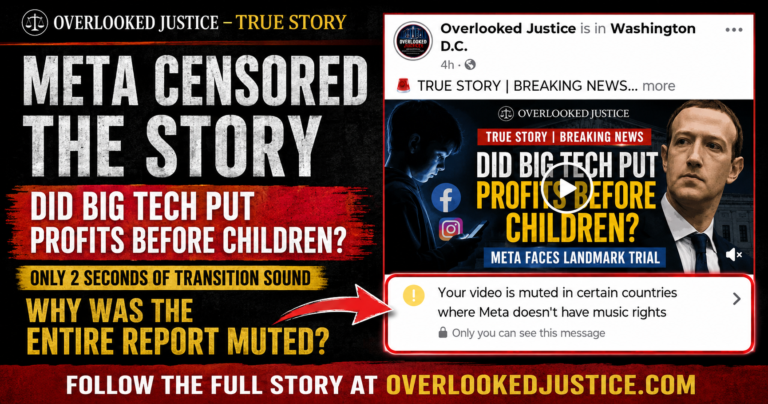
As the story began circulating on Facebook—reaching approximately 326 views and 47 shares—Meta placed the following notice on the video:
 “Your video is muted in certain countries where Meta doesn’t have music rights.”
What Music Did Meta Detect?
Overlooked Justice shared the report from Washington, D.C. We did not target or publish the video internationally. The reference to “certain countries” came directly from Meta.
The only music in the video is approximately two seconds of Overlooked Justice dramatic transition sound before the Investor Loans Plus AI sponsor feature.
The sponsor segment contains an AI voiceover—not a song or musical performance.
Yet the entire report was muted in certain countries instead of only the disputed two-second transition.
Meta’s visible notice did not clearly identify:
- The alleged song or recording
- The rights holder or claimant
- The affected countries
- The exact audio segment that triggered the restriction
 View the original Facebook post and Meta’s muting action:
https://www.facebook.com/share/v/1GzA3jasK7
The original post will remain available as documented evidence while Overlooked Justice republishes the report without the two-second transition sound.
Automated Enforcement or Selective Gatekeeping?
This was not an entertainment video centered on commercial music. It was public-interest reporting about Meta, children’s safety, data privacy, allegedly addictive social-media designs, and a landmark lawsuit.
Meta may describe the restriction as an automated copyright match, licensing issue, or technical decision.
But the public should still ask:
Was muting the entire report a reasonable response to approximately two seconds of transition sound—or another example of disproportionate Big Tech gatekeeping?
 FEATURED BUSINESS | INVESTOR LOANS PLUS AI
 Real Estate Opportunity Doesn’t Always Wait for Traditional Financing.
From investment properties and fix & flips to DSCR, bridge, commercial and other real estate financing solutions, Investor Loans Plus AI helps investors explore funding options and connect with independent lending resources.
 Learn. Explore. Connect. Invest.
 Explore your financing options
Investor Loans Plus AI is an educational and connection platform and is not a lender. Financing is subject to independent lender underwriting and approval.
🤖⚠️ WHAT PEOPLE DON’T KNOW ABOUT AI
What many people don’t realize about Artificial Intelligence is how much it can learn from the information, conversations, behaviors and content humans provide every day.
But the bigger question is: How could that growing intelligence ultimately be used to influence, shape — or even control — human behavior on a global scale? 🌎
🎥 This is a must-listen conversation.
👂 Listen.
🔎 Pay attention.
📲 Share it with others.
⚠️ And prepare yourself for the rapidly changing AI world around us.
👉 Watch the video:
The future of AI isn’t just about what humans can do with AI — it’s also about what AI is learning from humans.
What Happened to Meta’s Promise to Resist Censorship?
Ahead of the 2024 presidential election, Meta CEO Mark Zuckerberg said he planned to resist future pressure from the White House to censor content on Meta’s platforms.
Watch Zuckerberg’s statement:
But restrictions on public speech do not occur only when a government official orders a post removed. They can also occur through automated detection systems, unexplained geographic restrictions, selective muting, reduced distribution, and disproportionate copyright enforcement.
Who protects public-interest reporting when a platform’s own systems restrict a story involving that same platform?
From Connecting Families to Controlling Public Stories
Facebook originally presented itself as a social network where people could share photographs, memories, and stories with family and friends.
Today, Meta has enormous influence over who sees a story, how far it travels, which voices receive distribution, and which audiences can hear it.
Facebook began by encouraging people to share their lives. Now the company controls many of the systems that determine how those lives and public stories are shared.
Meta Faces Potential $1.4 Trillion in Penalties
Meta is facing a landmark youth-safety trial involving allegations that Facebook and Instagram were designed to keep children engaged, improperly collected children’s data, and misled users about platform safety.
According to Meta’s court filing, four states are seeking as much as $1.4 trillion in penalties. Meta disputes the allegations and argues that the calculation is unsupported.
The outcome could reshape children’s online privacy, parental protections, addictive platform designs, social-media algorithms, artificial intelligence, and Big Tech accountability.
Watch: Meta Faces Potential $1.4 Trillion in Penalties:
Billions Paid—but Can Privacy Ever Be Restored?
Facebook previously paid a record $5 billion federal privacy penalty after the Federal Trade Commission accused it of deceiving users about their ability to control their personal information.
That money went to the United States Treasury—not directly to affected users.
A separate $725 million consumer privacy settlement provided payments to eligible users after legal and administrative expenses. But individual payments cannot fully repair permanent privacy damage.
Once personal information has been improperly accessed, shared, harvested, or monetized, money cannot place it back into the hands of its owner. That information may remain indefinitely in the dark clouds of data brokers, unauthorized collectors, political operatives, scammers, and data thieves.
The settlement may close, but the citizen’s digital damage may never end.
The Public Deserves Answers
Why was an entire investigative report muted over approximately two seconds of transition sound?
Which countries were affected?
Who claimed the audio?
Why did Meta not identify the disputed recording in the visible notice?
How many other public-interest stories have been subjected to similar automated restrictions?
We are removing the two-second transition sound and republishing the same report. The original muted post will remain available for comparison and public review.
Now there can be no music-related explanation for restricting the investigation.
A Final Question for the People
So, my question to the people is this: Is your desire—or addiction—to social media greater than your desire to protect your life, your privacy, and your permanent digital thumbprint?
—IAMV