
Some links on this page may be promotional or referral-based. Overlooked Justice may earn compensation from qualifying actions at no additional cost to you. Offers and availability are subject to third-party terms. Editorial integrity remains independent.
The People’s Voice Uncensored!
Millions Are Searching for Work — But Who Is Protecting Their Personal Information?
Across America, people are searching for employment, submitting résumés, completing online applications, and waiting for responses that may never come.
Some employment advertisements remain visible for months. Others disappear and return under the same company name. Many applicants are directed to unfamiliar websites or asked to submit personal information before speaking with an identifiable company representative.





The question every job seeker should be asking is simple: Is this an actual employment opportunity, and who is receiving my information?
There is a growing distinction between legitimate job openings, inactive or speculative listings often called ghost jobs, and outright employment scams designed to steal personal information or money.
A posting that remains online for six months is not automatically fraudulent. Likewise, an employer’s failure to respond does not prove criminal intent. However, both should encourage applicants to verify whether the position remains available before sharing additional information.
🎥 WATCH THE NEWS REPORT — SCAM JOB POSTINGS ON THE RISE
 FAKE JOBS — REAL VICTIMS! IS YOUR IDENTITY BEING STOLEN WHILE YOU SEARCH FOR WORK?
 WATCH: Fake job advertisements can be more than wasted opportunities. Criminals may use fraudulent recruitment schemes to collect personal information and target unsuspecting job seekers.
Before you submit another résumé, WATCH THIS REPORT!
⚠️ The Research: Job Seekers Are Losing Trust
According to iHire’s 2026 State of Online Recruiting Report, which surveyed 1,054 job seekers:
41.2% reported encountering a fake or scam job posting within the previous year.
39.3% identified fake, fraudulent, or ghost jobs among their biggest job-search frustrations.
42.8% expressed frustration over difficulty determining whether an employer or employment advertisement was legitimate.
A separate 2026 Resume Genius survey of 1,000 active U.S. job seekers found that 67% had seen fake or misleading job postings, 55% identified unanswered applications as a major frustration, and 44% reported frustration with employers disappearing after interviews.
These findings do not establish that every questionable advertisement is fraudulent. They do establish that uncertainty and mistrust have become significant problems for job seekers.
MILLIONS SEARCHING FOR WORK — BUT ARE ALL THOSE JOB OPENINGS REAL?
WATCH: As Americans continue searching for employment, fraudulent job advertisements are creating serious risks for unsuspecting applicants.
Your desperation for employment should NEVER cost you your identity!
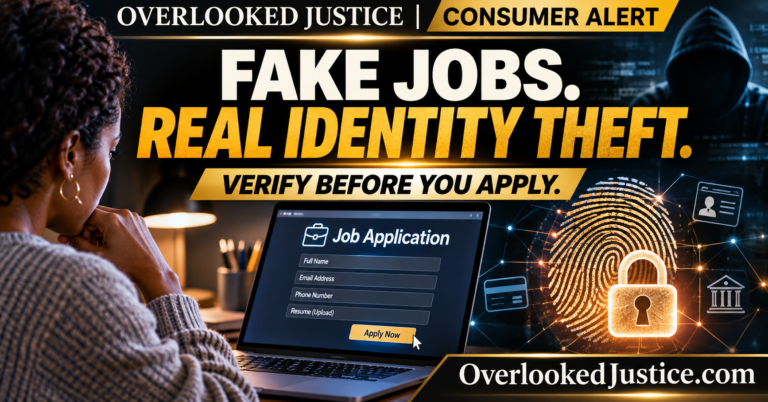
🔐 Your Résumé Is More Than a Document — It Is Part of Your Digital Fingerprint
What many applicants overlook is that a résumé and online application can reveal much more than professional qualifications.
Your full name, telephone number, email address, employment history, professional associations, location, educational background, and social media profiles can collectively create a detailed picture of your identity.
That accumulated information is part of your digital footprint, sometimes described metaphorically as your digital fingerprint or thumbprint.
It is not necessarily your actual biometric fingerprint. However, criminals can combine ordinary personal details with other stolen or publicly accessible information to impersonate someone, launch targeted phishing attacks, or attempt more serious fraud.
Even information that seems harmless when shared individually may become dangerous when combined with other records.
The FBI has specifically warned that criminals use fake recruitment advertisements, impersonated company representatives, fraudulent interviews, and counterfeit hiring websites to collect sensitive personal information.
🚨 Eight Dangers of Surrendering Your Digital Identity
- Identity theft: Criminals may use sufficiently detailed stolen information to impersonate applicants, obtain fraudulent identification, or commit other offenses under their names.
- Fraudulent loans and credit accounts: Stolen identifying information may be used in attempts to obtain credit cards, loans, or financial accounts without the victim’s authorization.
- Banking fraud: Fraudsters may use stolen account details, authentication information, or deceptive communications to access money or conduct unauthorized transactions.
- Tax refund fraud: Criminals with sufficient identifying information may attempt to file fraudulent tax returns and claim refunds belonging to someone else.
- Government benefits fraud: Stolen identities may be misused to submit false benefit applications or other government-related claims.
- Medical identity theft: Criminals may attempt to obtain medical services or insurance benefits using someone else’s identity.
- Account impersonation and takeover: Information collected through fake recruitment processes can support phishing, password-reset attacks, fraudulent communications, and attempts to gain access to online accounts.
- Repeated targeting and data exploitation: Personal information obtained through fraudulent applications may be reused, shared, or sold, exposing applicants to additional impersonation attempts and scams.
IMPORTANT: YOU DO NOT NEED EXCELLENT CREDIT TO BECOME AN IDENTITY-THEFT VICTIM.
A person with poor credit, limited credit, or no borrowing history can still experience identity theft, account fraud, tax-related fraud, financial losses, and serious administrative problems.
The value of someone’s identity extends far beyond their credit score.
🛑 Before Applying — Verify Who Is Behind the Advertisement
Job seekers should treat employment verification as a normal part of protecting their personal information.
Start by locating the company’s official website independently, rather than relying exclusively on a link inside a job advertisement.
Check whether the advertised position appears on the employer’s actual careers page. If it does not, ask whether the position remains open and whether the listing is authorized.
Whenever practical, contact the employer’s human resources or recruiting department using a verified business phone number or email address. Ask for confirmation of the position, the company representative handling recruitment, and the legitimate application process.
A professional-looking website, an email address, or even a telephone conversation is not sufficient proof by itself. Criminals can impersonate people and businesses. Verification should come through independently established company channels.
Before submitting a résumé, remove unnecessary personal details. Your Social Security number, full date of birth, banking information, account passwords, driver’s license number, and financial records do not belong on a general résumé.
Certain information may legitimately be required later for hiring, background checks, eligibility verification, or payroll. Such requests should occur through verified, appropriate, secure procedures — not merely because an unknown recruiter demands them.
Do not pay an employer to obtain employment, purchase supposed mandatory equipment from an unverified source, or deposit a check and return a portion of the money.
And if a company cannot establish who it is, whether the position exists, or who will receive your information, you have every right to discontinue the application and move on.
⚖️ Employment Desperation Must Never Become an Opportunity for Exploitation
People searching for employment are often trying to support families, maintain housing, pay bills, and rebuild financial security.
They should not be pressured into sacrificing their privacy simply to be considered for an opportunity.
Employers and recruiting platforms should demonstrate accountability by maintaining accurate listings, removing positions that are no longer available, identifying authorized recruiters, and providing clear channels for applicants to verify legitimate openings.
The responsibility for preventing fraud does not belong to job seekers alone.
🛡️ What If You Have Already Submitted Sensitive Information?
Act promptly if you believe an employment advertisement was fraudulent.
Stop communicating with the suspected scammer. Preserve copies of messages, advertisements, application forms, telephone numbers, and website addresses.
If you shared passwords, change them immediately and enable multifactor authentication. If banking information was exposed, contact your financial institution.
Consider placing a free credit freeze with Equifax, Experian, and TransUnion if your identifying information may have been compromised. A credit freeze can help prevent new credit accounts from being opened, but it does not stop every form of identity theft.
Report suspected identity theft at https://www.identitytheft.gov/ and suspected employment fraud to the FTC or FBI.
🗣️ IAMV PERSPECTIVE — GOVERN YOUR OWN LIVES
Desperation for employment should NEVER require desperation with your identity.
You have the right to know who is collecting your information, why they need it, and whether a real opportunity exists.
Do not allow the promise of employment to silence your judgment.
No legitimate hiring process should require blind trust in an unidentified recruiter or unexplained demands for financial information.
Your résumé represents your experience. Your identity represents your life.
Protect both.
VERIFIED SOURCES & CONSUMER PROTECTION RESOURCES
iHire — 2026 State of Online Recruiting Report
https://www.ihire.com/resourcecenter/employer/pages/the-state-of-online-recruiting-2026
Resume Genius — 2026 Job Seeker Insights Report
https://resumegenius.com/blog/job-hunting/job-seeker-insights-report-2026
FBI — Cyber Criminals Use Fake Job Listings
https://www.ic3.gov/PSA/2020/PSA200121
FBI — Fraudulent Job Postings Impersonating Businesses
https://www.ic3.gov/PSA/2022/PSA220201
FTC — How to Spot a Job Scam
https://consumer.ftc.gov/consumer-alerts/2025/09/how-spot-job-scam
FTC — Credit Freeze Guidance
https://consumer.ftc.gov/consumer-alerts/2025/09/get-credit-freeze-stop-identity-thieves
Report Employment Fraud — FTC
https://reportfraud.ftc.gov/
Report Employment Fraud — FBI
https://www.ic3.gov/
Identity Theft Recovery
https://www.identitytheft.gov/
Supporting News Video
Scam Job Postings on the Rise as Millions of Americans Search for Work