Some links on this page may be promotional or referral-based. Overlooked Justice may earn compensation from qualifying actions at no additional cost to you. Offers and availability are subject to third-party terms. Editorial integrity remains independent.
A company settles allegations involving harm to millions of people. The announcement makes headlines. Attorneys receive millions. Individual consumers may receive only a few dollars.
Then comes the detail many people may overlook:
You can lose the right to pursue covered claims without joining the lawsuit, filing a claim, or cashing a settlement check.





AT&T’s settlement raises a question that deserves more than a headline:
How effectively does the process protect the citizens whose harm made the lawsuit possible?
AT&T: $59 MILLION IN ATTORNEY FEES—WHAT DO CUSTOMERS RECEIVE?
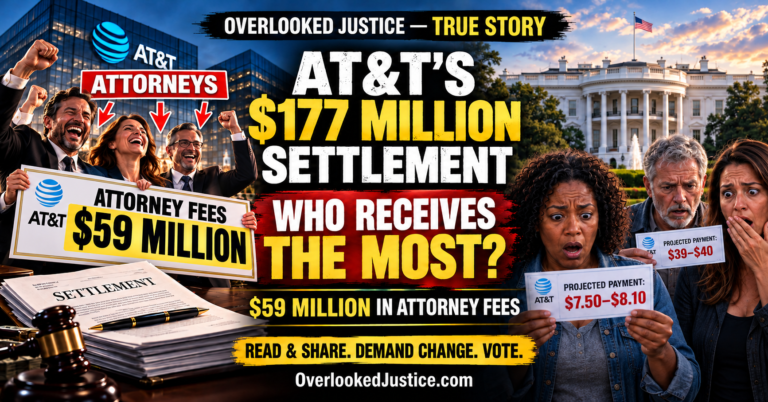
The court granted final approval to AT&T’s $177 million settlement on October 2, 2026. It addresses two data incidents disclosed in 2024.
Attorneys representing the customer classes were awarded $59 million—one-third of the settlement fund.
Reported projections for ordinary tiered customer payments are:
| Customer category | Projected payment |
|---|---|
| Social Security number exposed in the first incident | $39–$40 |
| Other covered information exposed in the first incident | $7.50–$8.10 |
| Eligible account owners affected by the second incident | $6.50–$7.10 |
These are projections, not guaranteed final payments. Separate documented-loss claims allowed qualifying requests up to $5,000 for the first incident and $2,500 for the second, with supporting evidence.
The legal teams collectively receive vastly more than any individual customer. That does not establish that attorney fees exceed all customer payments combined.
The public deserves both figures: the total delivered to customers and the amount each customer typically receives.
WATCH THE AT&T VIDEO
Supporting report: https://www.reuters.com/legal/government/plaintiffs-lawyers-att-class-actions-win-59-million-legal-fee-award-2026-10-05/
Customer-payment report: https://www.ctinsider.com/news/article/att-settlement-177-million-approval-payments-22462651.php
Public settlement records: https://www.telecomdatasettlement.com/documents
YOU NEVER JOINED—HOW CAN THE SETTLEMENT INCLUDE YOU?
Federal Rule 23 permits qualifying class actions to proceed through representatives and class counsel.
For a typical federal damages class, the court must require the best practicable notice, provide an opportunity to request exclusion, and determine whether the settlement is fair, reasonable, and adequate. Members who do not exclude themselves can be bound without actively participating.
AT&T’s notice states that doing nothing means receiving no settlement benefit while surrendering the right to separately pursue covered claims once the settlement becomes final. The opt-out deadline was November 17, 2025.
Not accepting a check does not necessarily preserve your rights.
That makes the notice process critical. Did the consumer receive it? Understand it? Recognize that inaction could carry lasting legal consequences?
An opportunity to reject an agreement is not the same as knowingly accepting it.
SUPPORTING STORY 1: META—BILLIONS FOR STATES, WHAT ABOUT FAMILIES?
On August 26, 2026, state attorneys general announced a settlement addressing allegations that Meta designed Facebook and Instagram features to encourage compulsive use among children and teenagers and misled the public about the risks.
New York’s official announcement describes a proposed settlement, subject to court approval, providing at least $12.1 billion to coalition states and potentially $17.1 billion if specified conditions involving other social media settlements are met.
The intended uses include youth mental-health services, education, and efforts to address harmful social media use. The agreement also requires changes involving age verification, time limits, nighttime access, notifications, and algorithmic feeds.
Some national reporting describes the broader package as up to $18 billion. That headline should not be confused with guaranteed cash already distributed.
Here, states are named financial recipients. The cited announcement describes public-service funding rather than an individual compensation check for every affected family.
Those services may benefit citizens. But families deserve to know which programs receive the money, who administers them, what fees are deducted, and whether the promised protections work.
Official settlement announcement: https://ag.ny.gov/press-release/2026/attorney-general-james-secures-171-billion-and-groundbreaking-reforms-meta
Supporting national report: https://www.reuters.com/business/meta-reaches-18-billion-settlements-over-childrens-social-media-addiction-2026-08-26/
SUPPORTING STORY 2: GOOGLE PLAY—$630 MILLION FOR CONSUMER RESTITUTION, $70 MILLION FOR STATES
Google’s $700 million Play Store settlement allocated $630 million for consumer restitution, subject to costs and fees, and $70 million in penalties to states and the District of Columbia.
Although the agreement dates to 2023, consumer payment notices began in December 2025.
This is a documented government allocation. It also shows why every case needs its own accounting: the consumer allocation here is substantially larger than the government allocation.
Money paid to a government is not automatically money paid personally to lawmakers. Citizens should demand records showing where it goes and how it is used.
Supporting settlement report: https://oag.dc.gov/release/attorney-general-schwalb-announces-700-million
Consumer-payment update: https://ag.ny.gov/press-release/2025/attorney-general-james-provides-new-information-consumers-receive-restitution
THE IAMV PERSPECTIVE: WHOSE VOICE COUNTS?
Class actions can make it possible to pursue claims that would be too expensive for individual consumers. Attorneys perform necessary work and assume financial risk.
But that does not place the process beyond public scrutiny.
Citizens deserve meaningful compensation, understandable notices, and a real opportunity to protect their claims.
AT&T’s case involves consumers represented as plaintiffs. Meta’s latest multistate agreement involves government enforcement. These are different legal processes, and the consumer class-action opt-out rules should not automatically be applied to the Meta agreement.
The public should ask the same financial questions in both:
Who receives the money? What does the harmed person receive? What accountability follows?
DEMAND CHANGE: CONTACT YOUR LAWMAKERS
Tell your elected representatives that consumer protection must include an understandable, meaningful opportunity to protect individual claims.
Demand reforms that provide:
- Clear warnings explaining which rights a settlement releases.
- Stronger safeguards when notices are missed or misunderstood.
- Consideration of affirmative consent before releasing individual damages claims.
- Public accounting of attorney fees, expenses, actual customer payments, government allocations, and remaining funds.
- Transparent tracking of government settlement spending.
Contact your state representative and state senator about state consumer-protection laws. Contact your U.S. representative and U.S. senators about federal class-action protections, including Rule 23.
Find and contact your federal and state elected officials: https://www.usa.gov/elected-officials/
DEMAND GOVERNMENT ACCOUNTABILITY: GOVERNMENT PERFORMANCE BONDS (GPB)
IAMV proposes Government Performance Bonds (GPB): required bonds for elected officials that pay when covered corruption or theft is established through a defined final legal finding.
The proposal should prioritize restoring stolen public funds and compensating proven direct losses, with personal accountability for responsible officials. It would require legislation and careful design.
Citizens should not bear the financial burden of officials’ misconduct again through poorly designed coverage.
Ask your lawmakers directly:
“If you support stopping government corruption and abuse, will you support developing and introducing Government Performance Bonds legislation? Will you provide your position in writing and explain the steps you will take?”
Support should be measured through concrete action: proposed legislation, public hearings, enforceable safeguards, and transparent oversight.
COPY AND SEND TO YOUR ELECTED REPRESENTATIVES
Dear Representative or Senator,
I am your constituent, and I am requesting stronger consumer protections and government accountability.
Consumers should receive clear notice and a meaningful opportunity to protect their claims before being bound by a class-action settlement. Please support reforms addressing missed or misunderstood notices, informed consent, settlement deductions, and public accounting of payments actually delivered to consumers.
I also ask you to support developing Government Performance Bonds (GPB) legislation requiring elected officials to maintain bonds that provide recovery when covered corruption or theft is established through a defined final legal finding.
This proposal should prioritize restoring stolen public funds, compensating proven direct losses, and holding responsible officials financially accountable. It should preserve criminal penalties, restitution, and existing victims’ rights.
If you support stopping government corruption and abuse, will you sponsor or support legislation advancing this proposal?
Please provide your position in writing, identify the actions you will take, and explain any concerns or alternative protections you propose.
Respectfully, [Your name] [Your city, state, and ZIP code]
Find your elected officials and their contact information: https://www.usa.gov/elected-officials/
READ. SHARE. DEMAND CHANGE. VOTE. 
A large settlement announcement does not answer whether justice reached the people who were harmed.
Contact your lawmakers. Request a written response. Follow their actions. Vote with accountability in mind.