Some links on this page may be promotional or referral-based. Overlooked Justice may earn compensation from qualifying actions at no additional cost to you. Offers and availability are subject to third-party terms. Editorial integrity remains independent.
Haiti Won Its Freedom in Blood. Then It Was Forced to Pay for It in Money. Two Centuries Later, Haitian Families in America Are Once Again Living With Fear, Uncertainty and the Threat of Being Forced Back.
There are stories we are taught.
And then there are stories buried so deeply beneath generations of politics, money and power that millions of people never learn how the past helped create the present.
Haiti is one of those stories.





Today, Haitian families across America are confronting another extraordinary period of uncertainty.
Temporary Protected Status protections that allowed hundreds of thousands of Haitians to legally live and work in the United States have been targeted for termination under President Donald Trump’s administration.
The consequences aren’t theoretical.
They are happening to real families.
Recent reporting describes Haitian immigrants afraid to leave their homes, churches with dramatically reduced attendance, workers losing employment authorization and families confronting the possibility of detention or deportation. Roughly 350,000 Haitians have been affected by the TPS termination.
For many Americans, that’s where this story begins.
 AT LEAST 100 MEMBERS OF LAST CONGRESS WERE DESCENDANTS OF SLAVE OWNERS
A Reuters examination of public documents and family records found that at least 100 members of the 117th Congress were direct descendants of slaveholders, including 28 senators.
The finding does not make today’s descendants responsible for their ancestors, but it shows just how closely America’s modern institutions and families remain connected to the history of slavery.
 WATCH: NBC NEWS
“At Least 100 Members of Last Congress Were Descendants of Slaveholders, Reuters Finds”
But Overlooked Justice went backward.
Because to overstand what is happening to Haiti and its people today, America needs to know what happened more than 200 years ago.
1804: THE ENSLAVED DEFEATED AN EMPIRE
Haiti’s story cannot begin with poverty.
It cannot begin with immigration.
And it certainly cannot begin with TPS.
It begins with freedom.
The people of the French colony of Saint-Domingue revolted against one of the most brutal systems of slavery in the world.
After years of warfare, Haitian revolutionaries defeated Napoleon Bonaparte’s forces.
On January 1, 1804, Haiti declared independence.
The formerly enslaved had defeated a European colonial power and established the world’s first independent Black republic.
That victory shook the slaveholding world.
The United States itself initially refused to recognize the new Haitian nation. The U.S. State Department’s historical record notes that President Thomas Jefferson pursued a policy of isolating Haiti amid fears surrounding the revolution. Formal U.S. recognition would not come until 1862 — nearly six decades after Haitian independence.
But France had another answer for the nation that defeated it.
Pay us.
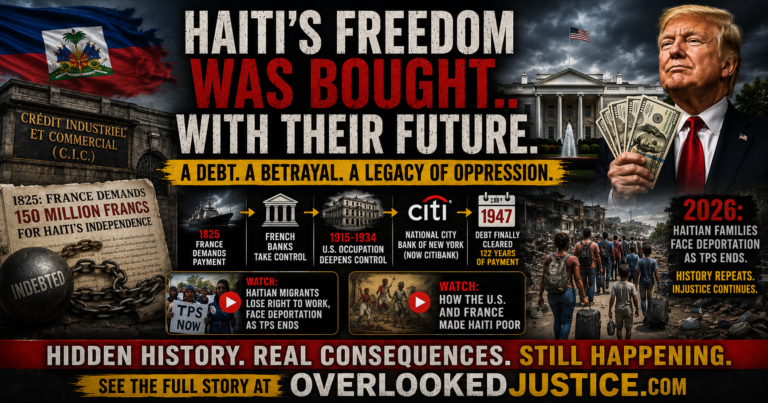
1825: FRANCE SENDS WARSHIPS — AND A BILL
Twenty-one years after Haiti declared independence, French King Charles X issued an ordinance recognizing Haitian independence.
But there was a price.
150 million French francs.
The money was intended to compensate former French colonists for property they claimed to have lost.
And among that “property” were enslaved human beings who had liberated themselves.
This is not folklore.
This is documented history.
An 1872 U.S. diplomatic report preserved by the State Department explicitly records Haiti’s 1825 commitment to pay France 150 million francs.
France didn’t simply send Haiti an invoice.
French warships accompanied the demand.
Haiti faced an impossible choice:
Accept the financial terms — or risk another war with France.
The country that had already paid for independence with the blood of its people was now being required to pay for that freedom financially.
WATCH: “How the U.S. and France Made Haiti Poor”
A video examination of the historical forces, foreign intervention and financial decisions that shaped Haiti after independence.
HAITI DIDN’T HAVE THE MONEY
There was another problem.
Haiti could not simply produce 150 million francs.
So the young nation entered into loans and refinancing arrangements that created additional interest, fees and financial obligations.
In other words:
Haiti went into debt to pay a debt imposed for winning its own freedom.
The original indemnity was eventually reduced, but the financial machinery surrounding Haiti did not disappear.
Debt followed debt.
Loan followed loan.
Generation followed generation.
The Council on Foreign Relations describes foreign intervention and debt as major obstacles to Haiti’s development and notes that enormous portions of Haitian government revenue were consumed servicing foreign obligations.
But the story becomes even more revealing when we follow the money.
ENTER CRÉDIT INDUSTRIEL ET COMMERCIAL
By the late 19th century, French banking interests became deeply embedded in Haiti’s financial system.
One institution deserves particular historical attention:
Crédit Industriel et Commercial — C.I.C.
In 1880, Haiti’s finance minister signed an agreement in Paris granting Société Générale de Crédit Industriel et Commercial the concession for the Banque Nationale d’Haïti — National Bank of Haiti.
That history is documented by Haiti’s own banking institutions.
Think about what that meant.
Decades after Haitians defeated French colonial rule, a French financial institution was involved in establishing the institution entrusted with important functions of Haiti’s national finances.
The National Bank of Haiti wasn’t headquartered in Haiti.
It was headquartered in Paris.
Historical financial records show that the bank was organized as a French corporation, with CIC instrumental in its creation.
Political colonialism had ended.
But financial dependence remained.
THEN THE MONEY TRAIL CROSSED THE ATLANTIC
The story didn’t end with French banks.
It eventually reached the United States.
And another enormous banking institution entered Haiti’s history.
National City Bank of New York.
Today, you know its successor as:
CITIBANK.
During the era surrounding the American occupation of Haiti, National City Bank became deeply involved in Haitian finance.
The United States occupied Haiti from 1915 until 1934.
During that period, American governmental power and American financial interests became intertwined with Haiti’s financial system.
Historical State Department documents show that the U.S. government dealt directly with National City Bank regarding control and transfer arrangements involving Haiti’s national bank.
Then came another enormous financial transaction.
1922: A $16 MILLION LOAN
In 1922, Haiti entered into a contract involving $16 million in 30-year, 6% gold bonds.
National City Bank of New York was appointed fiscal agent for the loan.
Again, this isn’t speculation.
The contract is preserved in the official historical records of the United States Department of State.
Part of the refinancing was used to deal with Haiti’s existing foreign debts.
The financial chain had shifted.
France.
French banks.
Haiti’s national banking system.
American financial interests.
National City Bank.
And Haiti remained the debtor.
1947: MORE THAN A CENTURY AFTER THE ORIGINAL DEMAND
The financial consequences originating in Haiti’s post-independence debt system stretched across generations.
The original indemnity imposed by France and the later loans used to refinance Haiti’s obligations are sometimes casually described as one single “independence debt.”
The historical reality is more complicated — and arguably more revealing.
There wasn’t simply one payment to one bank.
There was a financial chain spanning governments, loans, refinancing arrangements and financial institutions.
By 1947, Haiti finally completed repayment of the American-controlled financial obligations that had grown out of this broader debt history.
That was:
143 years after Haiti declared independence.
122 years after France imposed the 1825 indemnity.
Haiti had won the revolution in 1804.
Yet generations of Haitians were still living under international financial obligations more than a century later.
AND THEN WE ARRIVE AT 2026
Now look at America today.
Hundreds of thousands of Haitian immigrants built lives here under Temporary Protected Status.
They worked.
Paid rent.
Raised children.
Attended churches.
Cared for America’s elderly.
Worked in hotels.
Worked construction.
Worked in agriculture.
Built businesses.
Built communities.
And now many are confronting the loss of the protection that allowed them to legally remain and work in the United States.
Associated Press reporting in August 2026 documented Haitian communities where fear of immigration enforcement has caused people to remain inside their homes and avoid ordinary community activities.
Businesses are being affected as Haitian employees lose work authorization.
Healthcare and caregiving operations are confronting the potential loss of Haitian workers.
Families must contemplate returning to a country still suffering from extraordinary gang violence and political instability.
This isn’t merely an immigration statistic.
These are human beings.
Mothers.
Fathers.
Children.
Workers.
Neighbors.
Families.
WATCH: “Haitian migrants lose right to work, face deportation as TPS ends”
See the people behind the headlines as Haitian migrants confront the loss of work authorization and the possibility of deportation following the end of TPS protections.
FROM PORT-AU-PRINCE TO LITTLE HAITI
And that brings this history directly to communities such as Little Haiti in Miami.
For generations, Haitians have left their homeland searching for safety and opportunity.
But here’s the question rarely placed at the center of the discussion:
How can we discuss Haitian migration without discussing the history that helped destabilize Haiti?
How do we talk about Haitian poverty without talking about the enormous wealth extracted through colonial slavery?
How do we talk about Haiti’s economic struggles without discussing the indemnity imposed after independence?
How do we discuss Haiti’s national finances without discussing French banking influence?
How do we discuss the 20th century without discussing American occupation and National City Bank?
And how do we discuss Haitian immigrants today without acknowledging all of the history that came before them?
THIS IS BIGGER THAN DONALD TRUMP
President Trump’s current immigration policies are part of this story because his administration is responsible for the present TPS policy.
But Haiti’s story did not begin with Trump.
And intellectually, it would be dishonest to pretend that it did.
The timeline is much bigger.
Colonial slavery.
↓
Revolution.
↓
Independence.
↓
International isolation.
↓
The 1825 French indemnity.
↓
Loans to pay the indemnity.
↓
French banking influence.
↓
Foreign financial control.
↓
American occupation.
↓
National City Bank.
↓
Decades of additional debt.
↓
Political instability and economic hardship.
↓
Migration.
↓
TPS.
↓
2026 — hundreds of thousands facing uncertainty again.
That is the history worth examining.
HAITI WASN’T BORN POOR.
That may be the most important part of this entire story.
Saint-Domingue was extraordinarily valuable to France because enslaved Africans generated enormous wealth through sugar, coffee and other commodities.
Haiti emerged from a colonial system designed to extract wealth.
Then after Haitians destroyed slavery and declared independence, international isolation and an enormous indemnity imposed additional burdens on the new nation.
And generations later, we look at Haiti’s poverty as though it simply happened.
History says otherwise.
THE QUESTION OVERLOOKED JUSTICE IS ASKING
We are not telling readers that every problem Haiti faces today was caused by France.
It wasn’t.
We are not telling readers every Haitian government was blameless.
They weren’t.
Corruption, authoritarian governments, political violence, natural disasters, foreign intervention, international policy, economic decisions and modern gang violence all belong in an honest accounting of Haiti’s condition.
But acknowledging those realities does not erase another one:
Haiti began its life as a free nation carrying an extraordinary financial punishment imposed by the former colonial power it defeated.
That burden became intertwined with international banking and foreign political power for generations.
And that history deserves to be known.
HAITI PAID FOR FREEDOM.
First with human lives.
Then with money.
Then with interest.
Then through generations of financial obligations.
And now another generation of Haitians is asking where they will be permitted to call home.
Two hundred years separate the warships of 1825 from today’s immigration enforcement.
They are not the same event.
They should not be falsely presented as the same event.
But they belong to the same history of a people who have repeatedly had to fight to determine their own future.
That is the part of Haiti’s story too often overlooked.
And that is why we are telling it.
OVERLOOKED JUSTICE
The People’s Voice. Uncensored.
Hidden History. Real Consequences.
See the Full Story at OverlookedJustice.com
Story Prompt: OVERLOOKED JUSTICE HAITI
Overlooked Justice examines documented history, public records and current reporting. Historical financial arrangements changed repeatedly over more than a century; references to Haiti’s “independence debt” should distinguish the original French indemnity from subsequent loans, refinancing and American-controlled obligations.