Some links on this page may be promotional or referral-based. Overlooked Justice may earn compensation from qualifying actions at no additional cost to you. Offers and availability are subject to third-party terms. Editorial integrity remains independent.
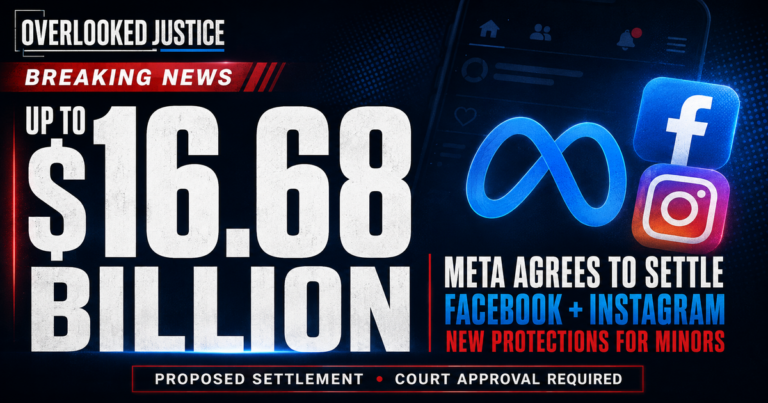
Meta has reached a proposed settlement worth as much as $16.68 billion, ending a landmark federal trial over allegations that Facebook and Instagram were designed to keep children compulsively engaged while the company misled families about the platforms’ safety.
The agreement, announced on August 26, 2026, would also require Meta to introduce nationwide protections for users under 18.
The settlement still requires court approval. Meta has denied wrongdoing, and the agreement does not constitute a judicial finding that every allegation against the company was proven.





Watch: Meta Agrees to $16.68 Billion Settlement
Watch the video: Meta Agrees to $16.68 Billion Settlement
What Meta Agreed to Change
Under the proposed settlement, Meta would implement new protections affecting how minors use Facebook and Instagram. Reported provisions include:
- Daily usage restrictions for users under 18
- Nighttime access blocks
- Stronger age-assurance systems
- Expanded parental controls
- No push notifications during weekday school hours
- Limits on social-comparison features, including public “like” counts
- Additional safeguards addressing bullying, eating-disorder and self-harm content
If approved and properly enforced, these changes could affect millions of children and families across the United States.
The settlement addresses consumer-protection claims brought by California, Colorado, Kentucky and New Jersey, along with federal children’s-privacy claims involving 29 states. The Associated Press reports that the broader agreement resolves claims involving 47 states.
The Trial Ended Before Zuckerberg Testified
The agreement cuts short a closely watched trial in which Meta CEO Mark Zuckerberg was expected to testify.
That timing matters.
A settlement can produce significant financial consequences and operational reforms without requiring a company to admit wrongdoing. But it can also prevent the public from hearing additional testimony, reviewing more internal evidence or receiving a jury verdict on the allegations.
The states accused Meta of intentionally designing Facebook and Instagram to foster compulsive use among children, misleading families about safety risks and collecting children’s personal information without proper parental consent.
Those were allegations being tested in court. The settlement resolves the government claims without establishing through a final verdict that every accusation was true.
Why This Matters to Parents and Children
This case was never only about screen time.
It raised larger questions about whether one of the world’s most powerful technology companies placed growth and engagement ahead of children’s health, safety and privacy.
Parents cannot meaningfully protect their children when companies possess information about risks that families do not have. Children are also especially vulnerable to addictive design features, constant notifications, social comparison, cyberbullying and recommendation systems that may repeatedly expose them to harmful content.
The proposed restrictions acknowledge that platforms can influence when children log on, how long they remain online, what content reaches them and how much social pressure they experience.
The most important question is no longer whether Meta can announce new protections. It is whether those protections will be independently monitored, consistently enforced and difficult to evade.
Free Speech, Business and the People Left Behind
Many people continue to report that their speech is censored, restricted or suppressed on major social-media platforms. When posts are removed, accounts are limited or reach is reduced without clear explanations or meaningful appeals, the consequences can extend far beyond personal expression.
Small businesses, independent journalists, creators and community organizations often depend on platforms such as Facebook and Instagram to reach customers, audiences and supporters. A sudden restriction can damage a business brand, reduce income, erase years of audience-building and make it difficult for people to communicate with the public.
This settlement does not appear to resolve those broader concerns. It focuses primarily on alleged harms involving minors, privacy and platform design. It does not provide a comprehensive remedy for users who believe their lawful speech was unfairly censored or whose businesses were harmed by opaque moderation and enforcement systems.
That distinction matters. A company can face serious accountability for protecting children while the public continues to demand answers about viewpoint discrimination, inconsistent content moderation, automated enforcement and the lack of due process available to ordinary users.
Where Will the Money Go?
Court documents place Meta’s maximum financial obligation at $16.68 billion, while the Associated Press describes the agreement as approximately $17 billion.
That figure should be reported carefully: Meta has agreed to pay up to $16.68 billion. It is not necessarily an immediate lump-sum payment of the full amount.
Important questions remain unanswered:
- How much will Meta ultimately pay?
- How will the money be divided among participating states?
- Will affected children and families receive any direct compensation?
- How will compliance with the new safeguards be tested?
- Can parents or users override the restrictions?
- How accurately will Meta identify underage users?
- What penalties will apply if Meta fails to comply?
- Will any portion of the settlement directly help people whose businesses or livelihoods were harmed by platform restrictions?
For many members of the public, the settlement may feel like another example of a legal system in which attorneys, government agencies and institutions receive the clearest benefits while the people allegedly harmed receive little or nothing directly.
Even a multibillion-dollar settlement can represent only a small fraction of a company’s value and future revenue. If most of the money is used for legal fees, administrative costs, government programs or negotiated enforcement measures, families, users and small businesses may see little practical relief.
Meta also continues to face thousands of separate lawsuits filed by families, school systems and other government entities. This agreement does not necessarily end every legal claim involving alleged social-media harm to children.
IAMV’s Perspective
IAMV, the founder of Overlooked Justice, states:
“This settlement is a drop in the bucket for Meta and does nothing to protect free-speech rights or address the censorship and gatekeeping by Meta that has caused many brands to suffer. Lawyers are the big winners, as always in settlements, leaving victims with little or nothing.”
This statement represents IAMV’s editorial opinion and assessment of the proposed settlement. The final distribution of the settlement—including attorneys’ fees, government allocations and any direct compensation for affected families—remains subject to the agreement’s terms and court approval.
Accountability Without an Admission
A potential $16.68 billion settlement is significant. Nationwide safety changes are significant. Ending a landmark trial immediately before Zuckerberg’s anticipated testimony is also significant.
But accountability should not be measured by the announced dollar amount alone.
Real accountability will depend on whether the agreement receives court approval, how much Meta ultimately pays, whether the protections meaningfully change children’s experiences and whether independent authorities can verify the company’s compliance.
It should also depend on whether ordinary users receive meaningful rights: clear explanations for account restrictions, timely appeals, consistent enforcement and protection against censorship that unfairly damages their speech, businesses or reputations.
Meta did not admit that it intentionally harmed children. No jury returned a verdict finding the company liable for every allegation.
What is verified is that Meta faced a landmark trial, agreed to a proposed settlement carrying a maximum value of $16.68 billion and committed to changing protections for minors on Facebook and Instagram.
The settlement may close one courtroom battle, but it does not close the larger public debate over what powerful technology companies knew, what they told families, whether profits were placed ahead of children and whether users have any meaningful protection when their speech or livelihoods are affected.
A settlement is not the same as justice. Justice requires that the people harmed are heard, that remedies reach them directly and that powerful institutions cannot treat public accountability as merely another operating expense.