Some links on this page may be promotional or referral-based. Overlooked Justice may earn compensation from qualifying actions at no additional cost to you. Offers and availability are subject to third-party terms. Editorial integrity remains independent.
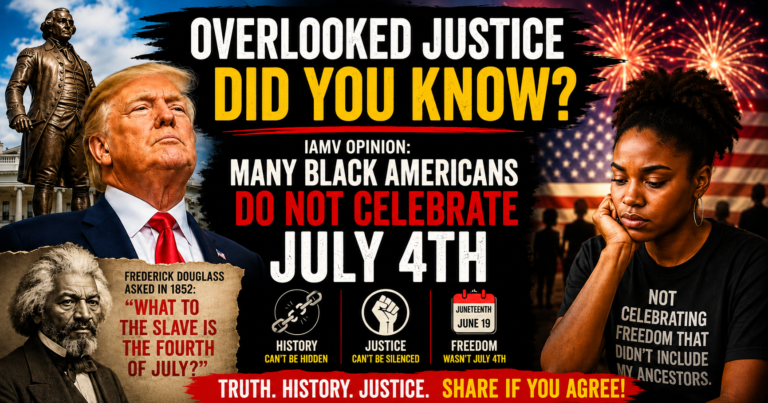
“What to the Slave is the Fourth of July?” — Frederick Douglass
Ecclesiastes 1:9 (ESV)
“What has been is what will be, and what has been done is what will be done, and there is nothing new under the sun.”
The injustice of a people still continues to this day, no matter the plausible arguments made to deny it exists. Modernized slavery continues to deny what is due, and those who deny it are now suffering too. The many times leaders have promised to give reparations for the free slave labor that built this nation have all too often been intentionally silenced, repeating the oppression of God’s people from generation to generation.





On July 4, 1776, while white Americans celebrated independence and the inalienable rights of “all men,” millions of Black Americans remained enslaved. This fundamental contradiction forms the basis of why many Black Americans do not celebrate the holiday, instead viewing it as a day of mourning, reflection, remembrance, and truth.
The Historical Reasons
The Stolen Labor and Continued Bondage
In 1776, freedom did not apply to Black Americans. Many of the Founding Fathers and signers of the Declaration of Independence owned enslaved people. While liberty was proclaimed, millions remained in bondage.
Frederick Douglass’s Condemnation
In his historic 1852 speech, abolitionist and former enslaved man Frederick Douglass asked:
“What to the Slave is the Fourth of July?”
Douglass described the celebration as an “inhuman mockery” and a “sacrilegious irony” while Black Americans remained subjected to the brutality of chattel slavery.
The Tradition of July 5th
Following the abolition of slavery in New York in 1827, many Black communities intentionally celebrated on July 5th instead of July 4th. The decision was made to avoid racist violence and to protest what many viewed as a secondhand version of American freedom.
Jim Crow and White Backlash
During segregation, Black Americans were frequently excluded from Independence Day celebrations or subjected to intimidation and violence. White supremacist groups disrupted Black parades and attacked Black communities, including during the 1876 Hamburg Massacre, reminding many that legal freedom did not equal equal treatment.
The Preference for Juneteenth
Today, many Black Americans choose to recognize Juneteenth (June 19) instead of July 4th. Juneteenth commemorates June 19, 1865, when the last enslaved people in Galveston, Texas, were finally informed they were free—more than two years after the Emancipation Proclamation.
Rather than celebrating an incomplete national freedom, many families spend the holiday reflecting upon their ancestors’ sacrifices, honoring those who endured slavery, and recognizing the continuing pursuit of justice, equality, and true liberty.
Trump Celebrates Installation of Slave Owner Statue Near the White House
President Donald Trump celebrated the installation of a statue honoring Caesar Rodney, a Founding Father and slave owner, near the White House, encouraging Americans to visit the monument as part of America’s 250th birthday celebration.
Rodney played an important role in the Continental Congress by casting the deciding vote for Delaware’s support of independence. At the same time, he was also a slave owner, making the statue a source of ongoing public debate following its removal during the Black Lives Matter protests in 2020.
For many Americans, the celebration of historical figures who simultaneously contributed to the founding of the nation while participating in slavery continues to raise questions about whose history is remembered, whose suffering is acknowledged, and whose contributions remain overlooked.
IAMV Opinion
The many contributions continue for generations by Black people, yet many continue to follow the promises of a debased mind, to do what ought not to be done, only to increase your suffering.
Yet God’s promise is before the entire world.
I witnessed the fight between good and evil on 12.24.19, and God was glorified.
These words I write before God I do not lie.
I’m a Vessel for the Lord.
Romans 1:18–32 (ESV)
Supporting Stories
It’s America’s 250th birthday. And Black Americans are sitting out the celebrations
By Morgan Jerkins – The Guardian
https://share.newsbreak.com/iwk45awk
Shocking July 4 poll finds nearly half of Americans don’t know what they’re celebrating on America’s 250th
The Independent
https://share.newsbreak.com/iwjqko52
Final Thought
When you see these things taking place—God’s Shift has begun.
May your spirits be filled with your greatness and strengthened by your ancestors that suffered before you—for you—and remember your chains.
“History can never be hidden, even by those who believe they control history.”
— IAMV