Some links on this page may be promotional or referral-based. Overlooked Justice may earn compensation from qualifying actions at no additional cost to you. Offers and availability are subject to third-party terms. Editorial integrity remains independent.
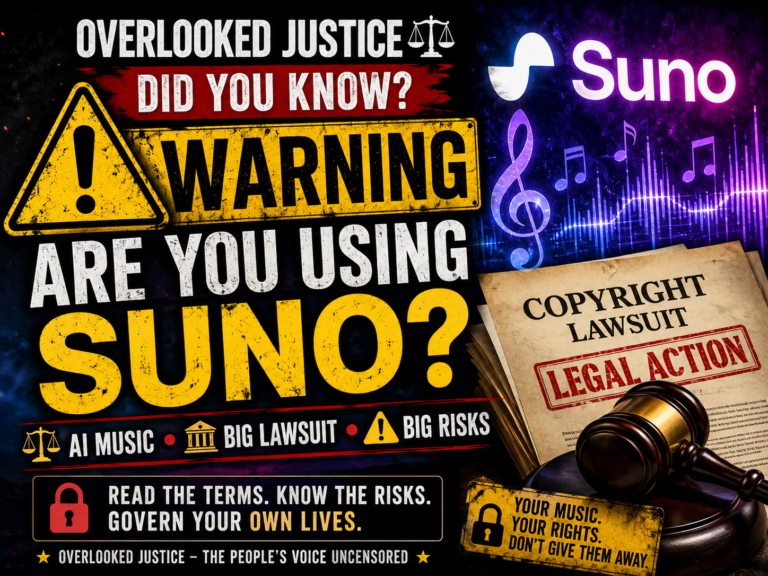
⚖️🎙️ Are You Using Suno? What You Should Know
Overlooked Justice Opinion – IAMV
In today’s digital world, companies that do business online… companies that market their services… often seem to hide behind the veil of Terms of Service 📜—buried in fine print, hidden from the eyes of consumers before people are fully aware of what they are actually entering into.
There should be a law ⚖️ requiring Terms of Service to be read in full before anyone can sign up to any service—even free services.
Because if people truly read these agreements before doing business, it would clearly display the type of business arrangement they are entering into… and many would run 🏃♂️💨





Why?
Because some agreements can take away your rights… your actual creative work… your intellectual property… and create contracts that can effectively steal from you without your full consent, knowledge, or understanding.
How these companies continue to operate like this against consumers is seen daily by those governing consumer protection… yet while special interests are protected, everyday consumers continue to suffer.
Many justifiable consumer complaints submitted to the United States Department of Justice by Overlooked Justice—fully documented—have received no meaningful resolution.
So many ask…
These agencies exist for what?
Much like the complaints made by victims connected to Jeffrey Epstein and the failures that followed.
Which is why I say:
⚖️ GYOL — “Govern Your Own Lives”
A law should be established requiring a clear disclosure checkbox ☑️ before anyone agrees to anything online.
And for those who say agreements are “too much to read”… technology now exists where AI can scan an agreement in minutes ⏱️ and give consumers a summary of exactly what they’re agreeing to—and highlight the red flags 🚩 they should know about.
Which Brings Me To Suno 🎵
Suno is a generative AI music platform that allows anyone to create full, studio-quality songs—including vocals, instrumentation, and lyrics—from simple text prompts.
You can use it from your browser or mobile app and generate complete tracks in seconds… regardless of your musical background.
Many people are using their talents to quickly make music on Suno because it seems fast… easy… and exciting.
But it comes with a few catches that many users may not be aware of.
🚨 The Catch You Should Know
One of the biggest questions creators should ask is:
Can AI companies scrape your content?
Whether Suno’s model can scrape content from YouTube, Spotify, or even your own website 🌐 depends on what type of content we’re discussing.
1️⃣ Publicly Available Internet Content
Yes—AI companies often rely on automated web crawlers and scraping technologies to gather publicly available internet data.
This may include:
✔ Public websites
✔ Public text and metadata
✔ Video descriptions
✔ Public transcripts
✔ Audio-related metadata
This practice is at the center of major copyright lawsuits happening right now.
If you own a website and want to reduce AI scraping, developers often recommend:
✔ Updating your robots.txt file
✔ Blocking AI crawlers
✔ Using CAPTCHAs
✔ Implementing bot-detection software
2️⃣ Content You Upload Directly Into Suno
According to Suno’s Terms of Service, when you upload content into their platform:
✔ Lyrics
✔ Audio samples
✔ Prompts
✔ Inputs
✔ Generated outputs
…you may be granting Suno a broad license to use that content to:
✔ Improve their systems
✔ Train AI models
✔ Develop future machine learning products
That means creators should understand exactly what they’re agreeing to before uploading their original ideas.
3️⃣ Music Published To Streaming Platforms
If you upload music to Spotify or other public ecosystems, that music becomes part of the broader digital ecosystem.
The legal question of whether AI companies can use publicly accessible streaming data for model training remains heavily contested in court.
 The Current Legal Reality
🧑⚖️ The Current Legal Reality
Suno is currently navigating multiple major copyright lawsuits across the United States 🇺🇸 and Europe 🇪🇺.
The Recording Industry Association of America, representing labels including Universal Music Group, Sony Music Entertainment, and Warner Music Group, accused Suno of training AI models on copyrighted recordings without permission.
 Warner Music Group Changed The Game
🎧 Warner Music Group Changed The Game
In late 2025, Warner Music Group settled its lawsuit with Suno and entered into a licensing partnership, allowing certain artists to opt in and participate in AI music opportunities.
For those who want to hear industry discussion around this:
But while Warner settled…
Universal and Sony are still actively fighting Suno in federal court.
 In Closing
🎯 In Closing
The bottom line…
We should all be tired of companies stealing from creators.
Work with real producers 🎚️
Work with real musicians 🎸
Work with real artists 🎤
And above all…
 Always Be Original
✊ Always Be Original
Stop giving your hard work… your gifts… and your talent away.
Because your creativity was given to you—not to be quietly repackaged by systems built on the backs of creators.