Some links on this page may be promotional or referral-based. Overlooked Justice may earn compensation from qualifying actions at no additional cost to you. Offers and availability are subject to third-party terms. Editorial integrity remains independent.
What Does the Constitution Say About Freedom of Religion, Free Speech and Social Media?
Have you ever told someone:
“God Bless You.” 
Or simply: “I’m praying for you.”



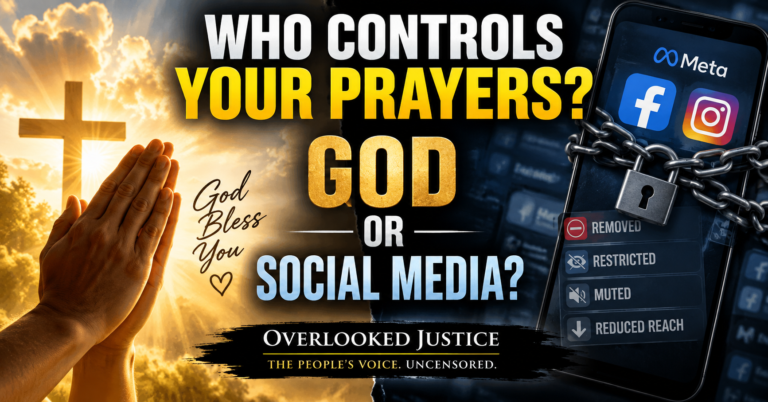
Maybe they lost someone. Maybe they’re sick. Maybe they’re struggling and just needed encouragement.
You send those words because that’s your faith and your way of caring for another person.
But here’s a question:
Who decides whether they actually get to see your prayer?
You?
Them?
Government?
Facebook?
Instagram?
Or an algorithm you cannot see?
 WHAT DOES THE CONSTITUTION SAY?
The First Amendment says:
“Congress shall make no law respecting an establishment of religion, or prohibiting the free exercise thereof; or abridging the freedom of speech…”
Freedom of religion.
Freedom of speech.
But the public square has changed.
Today we pray, debate, share news, encourage others and express our beliefs through social media.
And that means someone else now controls part of the pathway between your voice and another person’s screen.
PRESIDENT TRUMP SAID RELIGION SHOULD BE PRACTICED PUBLICLY
No matter how you personally view President Donald Trump, consider his words.
In his 2026 Religious Freedom Day proclamation, President Trump said:
“Every person is born with the God-given right to practice their faith, follow their conscience, and worship their God freely and without fear.”
He also said religious freedom means being able to practice your religion:
“proudly, publicly, and without fear of persecution.”
His Religious Liberty Commission was also directed to examine Americans’ ability to exercise their faith without fear of government censorship or retaliation.
So here’s the conversation:
What does practicing your religion “publicly” mean in the digital age?
Because today’s public square includes Facebook, Instagram and other social-media platforms.
 WHO DECIDES WHAT YOU SEE — AND WHAT YOU NEVER SEE?
This isn’t only about which post appears first.
Meta has publicly acknowledged different ways it handles information.
Content can receive greater distribution.
Other content can receive reduced distribution.
Some content isn’t recommended.
Content can be restricted or muted.
And content can be removed entirely.
Meta has described its approach as:
“Remove, Reduce and Inform.”
Think about those words.
If something is reduced, fewer people may encounter it.
If something is removed, the public doesn’t get to see it at all.
That’s an enormous amount of power over modern communication.
So who decides what moves forward?
Who decides what gets held back?
And who decides what disappears completely?
 WHAT IF THE INFORMATION CAME FROM CONGRESS?
Now the conversation gets even more interesting.
Congress holds public hearings.
The testimony is public.
The questions are public.
Americans have a right to hear what their elected representatives are discussing.
On January 31, 2024, the Senate Judiciary Committee held its public hearing:
“Big Tech and the Online Child Sexual Exploitation Crisis.”
Meta CEO Mark Zuckerberg appeared alongside executives from Discord, Snap, TikTok and X.
So consider this:
What happens when public congressional footage concerning Meta is shared on a platform controlled by Meta?
If that content is muted, restricted, reduced or removed, who explains why?
Facebook should explain Facebook.
We don’t need to make the explanation for them.
Let the people see the evidence and decide.
 NOW WATCH — THEN ASK YOURSELF
Before we go any further, listen to these two conversations about free speech and social media.
Elon Musk on Free Speech
What Are Your Free Speech Rights on Social Media?
Now that you’ve heard more about the rights you do—and don’t—have when using privately owned social-media platforms, there’s another question worth asking:
What are we giving these companies in return?
Our posts.
Our videos.
Our photographs.
Our comments.
Our shares.
Our attention.
And information generated through our use of their platforms.
Our participation helps make these platforms valuable.
So people, what do you think about that relationship?
We participate.
We create content.
We share our lives.
We help build audiences and communities.
The companies own the platforms and establish the rules governing what stays, what gets reduced and what gets removed.
And then there is another conversation that affects virtually everyone online:
How well is our personal data being protected?
That’s a separate question from free speech—but it’s one the public should continue asking.
How much information are we giving these companies?
What happens to it?
Who has access to it?
And what responsibility should companies have to protect it?
What do YOU have to say?
NOW COME BACK TO THREE SIMPLE WORDS
“God Bless You.”
Maybe tomorrow it’s:
“I’m praying for you.”
Or scripture.
Or a prayer for someone’s dying parent.
Or encouragement for someone who has lost hope.
Should a social-media platform determine whether the person you intended those words for gets to see them?
And if your peaceful expression of faith is removed completely, shouldn’t you know exactly why?
This isn’t only about Christianity.
It’s about the freedom of every person to peacefully express their faith—or choose not to believe at all.
Freedom isn’t freedom only when we agree with each other.
 SO WE’RE ASKING YOU
Have your Facebook or Instagram followers told you:
“I don’t see your posts anymore”?
Has your reach suddenly changed?
Have you had something removed, muted or restricted?
Have prayers, scripture or peaceful religious messages been affected?
Did Facebook give you a reason that didn’t appear to match what you actually posted?
Tell Overlooked Justice what happened.
Not what you think we want to hear.
Tell us what actually happened to you.
And if you have evidence:
 Save your screenshots.
 Save your analytics.
 Save Meta’s notices. Save your original videos.
 Save the dates.
Because the people’s experiences matter.
 YOU DECIDE
We’re not here to tell you what conclusion to reach.
We’re asking a much bigger question:
Who decides what you see?
Who decides what you’re allowed to share?
Who decides what gets removed so you never see it at all?
And that brings us to perhaps the simplest question in this entire story:
Who should have the power to stand between you and the person you’re praying for?
Meta or God?
Let the evidence speak.
Let the people decide.
And let Facebook explain Facebook