
Some links on this page may be promotional or referral-based. Overlooked Justice may earn compensation from qualifying actions at no additional cost to you. Offers and availability are subject to third-party terms. Editorial integrity remains independent.
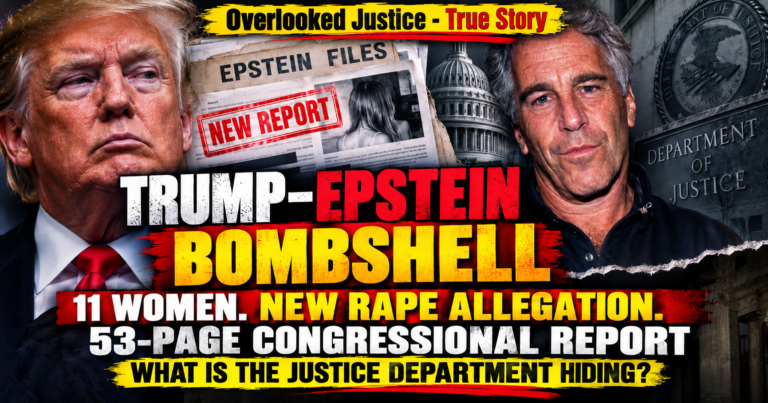
A congressional report released October 26, 2026, accuses President Donald Trump of involvement in Jeffrey Epstein’s abuse of women and raises serious questions about the Department of Justice. But allegations are not convictions. Will the American people ever see a complete, independent investigation?
THE REPORT THAT COULD REOPEN ONE OF AMERICA’S BIGGEST SCANDALS
WASHINGTON, D.C. — October 26, 2026.
A new 53-page congressional staff report has placed President Donald Trump’s relationship with convicted sex offender Jeffrey Epstein back under intense public scrutiny.





Released by Democratic staff of the U.S. House Judiciary Committee under Ranking Member Jamie Raskin, the report examines accounts involving 11 women, five of whom have directly accused Trump of rape or sexual assault in circumstances involving Epstein.
It also accuses the Department of Justice and FBI of withholding important information, closing investigative avenues, and failing to fully examine individuals who may have participated in Epstein’s criminal activities.
The report goes further than simply documenting a friendship between two powerful men. Its authors allege that Trump may have actively participated in or facilitated sexual misconduct connected to Epstein’s world of wealthy associates, modeling agencies, beauty pageants and private gatherings.
But an essential distinction must be made: These are findings and allegations presented by Democratic congressional staff, not criminal convictions or judicial determinations against Trump.
The White House denies the allegations.
And that raises the central question of this investigation:
If the evidence is as serious as Congress alleges, why should the public accept anything less than an independent examination of the complete records?
THE 11 WOMEN: WHAT CONGRESSIONAL INVESTIGATORS ACTUALLY FOUND
The report draws on FBI records, testimony, previously released documents, interviews with survivors, and information obtained under the Epstein Files Transparency Act.
Its authors describe three categories of accounts:
- Five women directly accused Trump of rape or sexual assault in circumstances involving Epstein.
- Three women described interactions that investigators interpreted as potentially involving attempts by Epstein or Ghislaine Maxwell to make them sexually available to Trump.
- Three additional women appeared in records describing overlapping personal or potentially sexual relationships within Trump’s and Epstein’s social circles.
These distinctions matter. Not all 11 women accused Trump of assault, and not every association described in the report is evidence of a crime.
Nevertheless, congressional investigators believe the combined accounts warrant a full criminal investigation.
The report describes a social environment in which influential businessmen, modeling agents, and individuals connected to Epstein allegedly used professional opportunities, promises of employment, access to education, and invitations to exclusive events to approach young women.
Were legitimate career opportunities being used to conceal exploitation? And who knew what was happening?
These questions deserve answers based on evidence, not political allegiance.
THE NEW BEATRICE KEUL RAPE ALLEGATION
Among the report’s most consequential developments is new testimony-related information from former Swiss model and beauty-pageant contestant Beatrice Keul.
Keul told Democratic committee staff that Donald Trump raped her during a November 1993 event associated with the American Dream Pageant at the Plaza Hotel in New York City.
According to her account in the report, Trump offered assistance with immigration arrangements and admission to New York University.
She also described meeting Jeffrey Epstein, who allegedly introduced himself as a close friend of Trump and invited her to attend parties at Mar-a-Lago.
Keul alleged that she was subsequently assaulted in a hotel suite and pressured to remain silent.
The report says photographs and other information support aspects of her account regarding the pageant and her interactions with Trump.
An important difference between earlier and newer accounts must also be examined.
In October 2024, Keul publicly alleged that Trump groped her but described being able to fend off his advances.
In the October 2026 congressional report, she alleges a completed rape.
The report says she previously withheld the fuller details and provided them during interviews with committee staff.
This difference does not automatically establish that her allegation is true or false.
It is a material development that independent investigators should examine through interviews, contemporaneous records, and any available corroborating evidence.
At present, the public report does not independently prove that the alleged rape occurred.
The allegation is serious enough to investigate. It should not be presented as an established conviction.
OTHER WOMEN DESCRIBE TROUBLING ENCOUNTERS
The report also revisits allegations made by several other women.
Stacey Williams alleged that Trump groped her in Trump Tower while Jeffrey Epstein stood nearby.
Jill Harth alleged in a 1997 lawsuit that Trump forcibly kissed and fondled her. She also described incidents involving other young women during events associated with Trump.
A woman using the pseudonym Katie Johnson alleged that Trump and Epstein sexually abused her when she was 13. Her allegations have not been established in court.
Maria Farmer, an Epstein survivor, described an encounter in which she said Trump approached her in a sexually threatening manner before Epstein intervened.
A survivor identified as Jane, who testified in the criminal case against Ghislaine Maxwell, described Epstein introducing her to Trump when she was 14. Her account raises questions about what the adults present knew about her age and circumstances, but it is not itself an allegation that Trump sexually assaulted her.
Each account requires examination on its own merits.
The fact that multiple people have made allegations is significant. It does not eliminate the need to test their statements and supporting evidence individually.
DID THE JUSTICE DEPARTMENT KEEP IMPORTANT EVIDENCE FROM THE PUBLIC?
The congressional report’s allegations against the Department of Justice may be just as consequential as its claims concerning Trump.
Investigators contend that federal officials restricted disclosure of information related to Epstein’s associates and failed to pursue potential co-conspirators adequately.
One episode receiving particular attention involves Todd Blanche, Trump’s former defense attorney, who subsequently served as deputy attorney general.
During a July 2025 interview with convicted Epstein associate Ghislaine Maxwell, Blanche interrupted discussions concerning a survivor identified as Jane.
The publicly released interview transcript includes Blanche saying:
“Let’s not talk about individuals.”
The Democratic report argues that these interruptions may warrant examination for possible witness tampering or obstruction.
However, the transcript alone does not prove criminal intent or establish that Blanche committed those offenses.
THE QUESTIONS REMAIN:
Who determined which Epstein-related evidence would be released?
Were investigative decisions made independently of political considerations?
Were legitimate law-enforcement inquiries halted or restricted?
And will the Department of Justice provide records needed by state, federal and foreign authorities pursuing related cases?
The American people deserve documented answers.
 RELATED VIDEO: EPSTEIN WHISTLEBLOWER DIES — WHO PROTECTS THOSE WHO EXPOSE POWERFUL CONNECTIONS?
WATCH: THE YOUNG TURKS — “EPSTEIN WHISTLEBLOWER FOUND DEAD RIGHT AFTER EXPOSING TIES”
The video discusses the death of Simon Andriesz, a 57-year-old former British banker who raised concerns about financial wrongdoing at BGC Group and identified documents concerning connections between Jeffrey Epstein and U.S. Commerce Secretary Howard Lutnick.
Andriesz previously brought information to federal authorities and congressional investigators. His disclosures raised questions about Lutnick’s business and personal associations with Epstein.
Andriesz died on September 23, 2026, in Thailand. According to BBC reporting, his family said he died by suicide and that there was no suggestion of foul play.
Following his death, Britain’s Financial Conduct Authority announced a review of how it had handled his whistleblower disclosures and complaints concerning his treatment.
BGC disputed allegations of retaliation, and Lutnick has denied wrongdoing related to Epstein.
WHY THIS VIDEO MATTERS:
This is a separate but relevant account about the handling of Epstein-related records and the protections available to people who report alleged wrongdoing involving powerful individuals.
Andriesz’s death does not establish that anyone caused his death or that his disclosures resulted in a criminal cover-up. Nor does this separate case prove the allegations against Trump in the October 26 congressional report.
The question remains: When individuals come forward with potentially important evidence, are institutions doing enough to protect them and ensure their information receives an independent examination?
TRUMP AND EPSTEIN: WAS THE RELATIONSHIP MORE EXTENSIVE THAN PREVIOUSLY ACKNOWLEDGED?
The congressional report also challenges several statements Trump has made about his past relationship with Epstein.
The men attended social events and circulated among prominent business figures and wealthy individuals during the 1990s.
The report points to flight records, photographs, historical statements and other documents that its authors contend contradict parts of Trump’s public account.
According to the report, records indicate Trump traveled aboard Epstein’s aircraft multiple times during the 1990s despite later denying that he had flown on the plane.
Investigators also question competing explanations about how Epstein’s relationship with Trump ended.
These issues may help clarify the nature and extent of their association.
But appearing in photographs, traveling on an aircraft or knowing a convicted criminal does not, by itself, establish participation in criminal wrongdoing.
The essential investigative question is whether reliable evidence connects particular individuals to particular crimes.
That is the standard any credible investigation must follow.
WHAT DOES THE WHITE HOUSE SAY?
The Trump administration has forcefully rejected the report.
In an October 26 statement to Spectrum News, White House spokeswoman Lauren Bis said:
“None of these allegations are true.”
The White House characterized the report as politically motivated and reiterated its claim that Trump expelled Epstein from Mar-a-Lago.
It also maintained that Trump had been exonerated of Epstein-related wrongdoing.
However, the administration’s claim of exoneration should not be confused with a court ruling resolving each new allegation.
Trump has consistently denied knowledge of, or participation in, Epstein’s sexual abuse and trafficking activities.
These denials, along with the report’s allegations, should be evaluated against the available evidence.
WHAT HAS ACTUALLY BEEN PROVEN IN COURT?
There is an important difference between criminal charges, civil findings, congressional allegations and political statements.
Jeffrey Epstein pleaded guilty to Florida state prostitution-related offenses in 2008.
He was later federally charged with sex trafficking of minors in 2019 and died in custody before that case proceeded to trial.
Ghislaine Maxwell was convicted in federal court in 2021 of crimes connected to Epstein’s abuse of minors.
In a separate case unrelated to Epstein, a federal civil jury found Trump liable for sexually abusing and defaming writer E. Jean Carroll in May 2023.
That civil finding does not prove the accusations in the October 2026 Epstein report.
Likewise, the 53-page congressional report is not a criminal verdict against Trump.
The distinction is fundamental to honest journalism.
CONGRESS DEMANDS AN INDEPENDENT SPECIAL COUNSEL
Jamie Raskin and the Democratic members responsible for the report want an independent special counsel appointed to examine Epstein’s potential co-conspirators, the handling of evidence, and possible misconduct by federal officials.
They also want greater cooperation with other jurisdictions seeking Epstein-related records.
The report identifies what its authors view as sufficient grounds to open or renew investigations.
Whether the legal requirements for appointing a special counsel are met, and whether any conduct warrants criminal charges, remain questions for the appropriate authorities.
The report itself does not establish that a new special counsel has been appointed or that its accusations have resulted in criminal charges against Trump.
OVERLOOKED JUSTICE INVESTIGATION: WHAT IS CONFIRMED AND WHAT REMAINS UNPROVEN?
CONFIRMED:
- A 53-page House Judiciary Democratic staff report was released October 26, 2026.
- The report discusses accounts involving 11 women.
- Five women are identified in the report as having directly accused Trump of rape or sexual assault in circumstances involving Epstein.
- Beatrice Keul’s new allegation is described in substantially greater detail than her earlier public statements.
- The Department of Justice published transcripts of Blanche’s 2025 interview with Maxwell.
- Democratic lawmakers have called for an independent special counsel.
- The White House denies the allegations.
NOT ESTABLISHED BY THE REPORT ALONE:
- That Trump committed the alleged Epstein-related sexual crimes.
- That every allegation described is independently corroborated.
- That Justice Department officials committed criminal obstruction or witness tampering.
- That everyone identified in the report participated in sex trafficking.
- That a court has found Trump guilty of an Epstein-related criminal offense.
The public should know the difference between evidence, allegation, inference, and legal proof.
IAMV PERSPECTIVE: WHEN POWER CONTROLS INFORMATION, WHO PROTECTS THE PEOPLE?
America has reached a point where the public must ask uncomfortable questions about the institutions trusted to investigate wrongdoing.
What happens when an investigation involves influential politicians, wealthy business leaders, powerful attorneys, or individuals with control over government institutions?
Who determines which documents the public receives?
Who decides whether allegations deserve further investigation?
And can citizens reasonably expect accountability when those accused hold positions of extraordinary influence?
These questions do not belong to Democrats or Republicans alone.
They belong to every American.
Justice cannot be defined by political office, financial influence, party affiliation or personal loyalty.
Survivors deserve to be heard.
The accused deserve a fair examination of the evidence.
Investigators must follow facts without political interference.
And the public deserves transparency consistent with protecting victims, witnesses, legitimate investigations and due-process rights.
The release of a congressional report should not be the end of the story.
It should initiate further scrutiny of the underlying evidence, the contested claims, and the institutions responsible for investigating them.
The greatest danger to justice is a system in which the powerful are investigated by different standards than ordinary citizens.
That is a danger every generation must confront.
QUESTIONS EVERY AMERICAN SHOULD BE ASKING
- Should an independent special counsel examine the allegations in the new Trump–Epstein report?
- Why do serious questions persist about the completeness of the publicly released Epstein files?
- Should Congress require a comprehensive accounting of records withheld or redacted, while protecting survivors’ privacy?
- Should allegations involving wealthy or politically powerful individuals receive the same investigative treatment as allegations involving ordinary Americans?
- What safeguards are necessary to ensure that government investigators are independent of those they may need to investigate?
THE PEOPLE’S VOICE MATTERS
This is not simply a story about Donald Trump, Jeffrey Epstein or a congressional report.
It is a story about whether institutions entrusted with enforcing the law can earn the public’s confidence when the allegations involve the nation’s most powerful individuals.
Read the report. Review the evidence. Question the institutions. Demand transparency.
And remember: accountability should never depend on who occupies the White House.
READ. SHARE. ASK QUESTIONS. DEMAND ACCOUNTABILITY. VOTE.
By IAMV
OVERLOOKED JUSTICE
 THE PEOPLE’S VOICE UNCENSORED!
ORIGINAL DOCUMENTS & VERIFIED SOURCES
SOURCE 1 — U.S. House Judiciary Committee Democrats, October 26, 2026
Official congressional announcement:
SOURCE 2 — Original 53-page congressional report
SOURCE 3 — U.S. Department of Justice, Maxwell interview transcripts
https://www.justice.gov/maxwell-interview
SOURCE 4 — Spectrum News, October 26, 2026
Congressional report and White House response:
SOURCE 5 — The Independent, October 2024
Earlier reporting on Beatrice Keul’s allegations:
SOURCE 6 — NPR, May 2023
E. Jean Carroll civil jury verdict:
https://www.npr.org/2023/05/09/1174975870/trump-carroll-verdict
EDITORIAL DISCLOSURE: This article distinguishes verified public records, congressional allegations, witness statements, official denials and adjudicated court findings. Allegations not established in court are attributed to their sources. Material new evidence, court decisions and corrections will be reviewed as they become available.