Some links on this page may be promotional or referral-based. Overlooked Justice may earn compensation from qualifying actions at no additional cost to you. Offers and availability are subject to third-party terms. Editorial integrity remains independent.
Millions of Americans remember the message.
Get vaccinated.
For many workers, however, it wasn’t simply a recommendation.




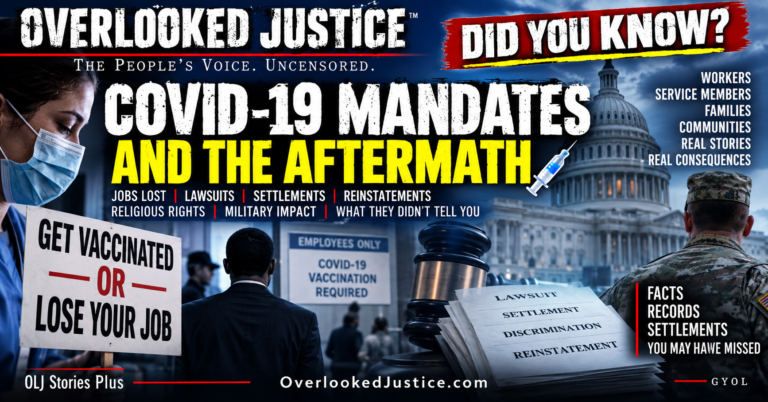
Their employment, careers, military service and ability to provide for their families could depend upon their decision.
Beginning in 2021, COVID-19 vaccination requirements spread through federal agencies, the military, health-care systems and private employers across the United States.
Some employees complied willingly.
Others objected for religious, medical or personal reasons.
Some requested exemptions.
Some were denied.
Some were given a direct choice: get vaccinated or lose your job.
Some were placed on leave.
Some lost their jobs.
Some service members saw their military careers interrupted or ended.
Years later, another part of the COVID-19 mandate story is still unfolding:
Lawsuits. Court decisions. Settlements. Reinstatements. Findings of unlawful discrimination.
That aftermath deserves to be part of the historical record.
THE MANDATES
In September 2021, President Joe Biden announced sweeping COVID-19 vaccination policies affecting federal employees, federal contractors, health-care workers and large private employers.
The administration argued that extraordinary measures were necessary to protect workers and the public during a deadly pandemic.
But the policies also produced an extraordinary legal and constitutional fight over the limits of governmental authority, workplace safety, religious liberty and individual rights.
One of the largest proposed requirements came through the Occupational Safety and Health Administration.
OSHA’s emergency standard would have required employers with at least 100 employees to require vaccination or regular testing and masking.
The dispute reached the United States Supreme Court.
On January 13, 2022, the Supreme Court blocked enforcement of the OSHA requirement, concluding that the challengers were likely to succeed in arguing that OSHA had exceeded the authority Congress had given the agency.
At the same time, the Supreme Court permitted a separate federal vaccination requirement for workers at health-care facilities participating in Medicare and Medicaid to proceed.
America therefore entered an unprecedented period in which the legality of a vaccination requirement could depend heavily upon who employed you and where you worked.
WHEN A MEDICAL DECISION BECAME AN EMPLOYMENT DECISION
For workers affected by these policies, the controversy wasn’t confined to Washington.
It entered workplaces and homes.
Employees had to decide whether to comply, seek an exemption, challenge their employer—or risk losing their livelihood.
Religious accommodation became one of the most consequential issues.
Title VII of the Civil Rights Act prohibits employment discrimination because of religion and generally requires employers to reasonably accommodate sincerely held religious practices and beliefs unless accommodation would impose an undue hardship.
COVID-19 did not erase those protections.
That distinction is critical.
The legal question in many of today’s cases isn’t simply whether an employer could establish a vaccination policy.
It is whether employers lawfully handled the people who requested religious or other legally protected accommodations.
THE MILITARY
The consequences also reached America’s armed forces.
Thousands of service members sought religious accommodations or faced separation under the military’s COVID-19 vaccination requirements.
The Department of Defense rescinded its COVID-19 vaccination mandate on January 10, 2023, following a requirement enacted by Congress.
Official Department of Defense Source:
But the issue didn’t disappear with the mandate.
The Defense Department later reported that nearly 8,000 active-duty and reserve service members had been involuntarily separated during the mandate period for refusing the vaccine. In 2025, the government moved to provide a pathway for qualifying former service members to seek reinstatement at their former rank.
Department of Defense Source:
Whatever one’s position on vaccination, the historical question remains:
What happens when a government policy ends after people’s careers and lives have already been affected by it?
THE AFTERMATH
For years, Americans heard enormous amounts of information about vaccinations, infections, hospitalizations and government public-health policy.
Far less public attention has been devoted to the employment cases that followed.
That is changing.
The Equal Employment Opportunity Commission—the federal agency charged with enforcing workplace discrimination laws—has investigated and resolved multiple matters involving COVID-19 vaccination policies and religious accommodation.
These are not simply claims circulating on social media.
They appear in official federal records.
LAWSUITS AND SETTLEMENTS THEY DIDN’T HEAR ABOUT
$15 MILLION — COVID-19 VACCINATION DISCRIMINATION RESOLUTION
On March 24, 2026, the U.S. Equal Employment Opportunity Commission announced a $15 million conciliation agreement involving a global technology company operating in twelve states.
According to the EEOC, its investigation found reasonable cause to believe the company discriminated against a class of employees based on religion and disability by denying COVID-19 vaccination exemption requests and terminating employees who declined vaccination.
The company voluntarily resolved the matter without admitting liability.
The agreement also required policy review, employee training and reporting to the EEOC concerning accommodation requests for three years.
Official EEOC Source:
The significance is difficult to ignore:
Years after the mandates largely disappeared from everyday American life, federal civil-rights enforcement surrounding their implementation continues.
MORE THAN $2.8 MILLION — UT-BATTELLE / OAK RIDGE NATIONAL LABORATORY
In September 2025, the EEOC announced that UT-Battelle LLC would pay more than $2.8 million in monetary relief to a class of employees.
The workers were associated with Oak Ridge National Laboratory and had requested religious accommodations from the organization’s COVID-19 vaccination policy.
The EEOC reported that its investigation found reasonable cause to believe UT-Battelle discriminated against employees based upon their sincerely held religious beliefs by denying religious accommodations.
The agreement included back pay and compensatory damages and required additional measures concerning religious-accommodation policies and training.
Official EEOC Source:
MORE THAN $1 MILLION — MERCYHEALTH
In August 2025, the EEOC announced another major resolution.
Mercyhealth agreed to provide more than $1 million in monetary relief to a class of employees.
According to the EEOC, its investigation found reasonable cause to believe employees had been discriminated against based on religion after being denied religious accommodations and either terminated or subjected to wage deductions.
Mercyhealth also offered reinstatement to employees it had terminated for refusing to comply with the COVID-19 vaccination policy.
Official EEOC Source:
$150,000 — REX HEALTHCARE, NORTH CAROLINA
The aftermath has reached North Carolina as well.
On March 2, 2026, the EEOC announced that Rex Healthcare would pay $150,000 to resolve a federal religious-accommodation lawsuit.
The case concerned a remote employee who sought a religious exemption from the employer’s mandatory COVID-19 vaccination policy.
According to the EEOC’s lawsuit, the employee previously received religious exemptions from flu vaccination requirements but was denied her COVID-19 exemption requests and ultimately fired in November 2021.
The settlement included damages and a two-year consent decree requiring measures addressing future religious discrimination and retaliation.
Official EEOC Source:
WHEN IMPORTANT STORIES RECEIVE ALMOST NO ATTENTION
IAMV Commentary
I perceive a troubling formula in the suppression of public-interest news—news established to inform the people.
Sometimes the pattern can be seen by simply doing the math.
Stories discussing COVID-19 settlements were published by established news outlets, including channels with large followings, yet some of these selected stories received remarkably few views or reactions even after remaining online for years.
This pattern can be seen across YouTube, Facebook and other major platforms.
This doesn’t seem accidental.
Many Americans may still be unaware that COVID-19-related lawsuits and settlements occurred at all—including people who may believe they have a complaint to file.
That lack of awareness can have serious consequences.
Time protects defendants when potential claimants don’t know their rights.
Statutes of limitations and other legal filing deadlines can expire. By the time someone discovers that other people brought similar claims, their own opportunity to seek legal relief may already have been affected.
Consider this published news report:
New Jersey to Pay Millions to 119 Families in Settlement Over COVID-19 Deaths at Veterans Home
The video was published approximately four years ago by a news channel that, according to the information documented during our review, displayed approximately 258,000 subscribers and 27,000 videos. Yet this particular report displayed only 91 views and no visible reactions.
The public should be able to see the information, examine the evidence and reach its own conclusions.
RELATED COVID-19 SETTLEMENT STORIES
VIDEO: Settlement Reached in Suit Seeking to Protect Prisoners from Coronavirus
Massachusetts Reaches $56 Million Settlement in Deadly Holyoke Soldiers’ Home COVID Outbreak
Judge Approves $58M Settlement for Holyoke Soldiers Home COVID Outbreak
These reports remain available for readers to view for themselves.
Look at the stories.
Look at when they were published.
Look at their visible engagement.
Then compare that with the public importance of what was being reported.
Use Wisdom and Knowledge to Discern.
Govern Your Own Lives. 

— IAMV
THE QUESTION AMERICA STILL HAS TO ASK
Public emergencies force governments to make difficult decisions.
COVID-19 killed and seriously sickened large numbers of people, overwhelmed hospitals and created enormous uncertainty.
Government officials and employers argued that vaccination requirements were necessary to protect public health and workplaces.
That is part of the historical record.
But another principle must be preserved alongside it:
EMERGENCY POWER DOES NOT AUTOMATICALLY ELIMINATE CIVIL RIGHTS.
When Americans requested religious or legally protected accommodations, the law still mattered.
When employees were terminated, their losses didn’t disappear when the mandates ended.
When service members’ careers were disrupted, rescinding the policy didn’t automatically give them those years back.
And when government agencies later conclude that particular workers were unlawfully discriminated against, those findings belong in the historical record too.
THE AFTERMATH IS THE STORY
The COVID-19 mandate debate is often presented as though it ended when the mandates ended.
It didn’t.
For some Americans, the mandate was only the beginning.
The aftermath became:
Lost employment.
Lost income.
Interrupted careers.
Religious-discrimination claims.
Court battles.
Government investigations.
Multimillion-dollar settlements.
Reinstatement efforts.
And years of trying to determine whether decisions made during an unprecedented emergency crossed legal boundaries that should remain protected even during a crisis.
America cannot properly evaluate what happened by remembering only the emergency.
We must also examine what happened afterward.
Because justice isn’t determined solely by what governments or corporations believed was necessary at the time.
Justice also requires examining what happened to the people who were required to live with those decisions.
THREE OFFICIAL RECORDS EVERY READER SHOULD EXAMINE
1. U.S. EEOC — $15 Million COVID-19 Vaccination Discrimination Resolution
March 24, 2026
The EEOC reported reasonable cause to believe a class of workers experienced religious and disability discrimination involving COVID-19 vaccination exemptions and terminations.
2. U.S. EEOC — UT-Battelle / Oak Ridge National Laboratory
September 30, 2025
More than $2.8 million in monetary relief involving employees who sought religious accommodations from a COVID-19 vaccination policy.
3. U.S. EEOC — Mercyhealth
August 13, 2025
More than $1 million in monetary relief, with reinstatement offered to employees terminated for refusing to comply with the vaccination policy.
LEGAL RESOURCE BOX
Individuals who believe they lost employment, were denied a legitimate religious accommodation or otherwise suffered unlawful discrimination because of a COVID-19 vaccination policy should understand that every case is fact-specific.
Important issues can include statutes of limitations, administrative filing deadlines, the employer involved, the date of termination, whether an accommodation was requested, documentation of that request and whether an EEOC charge was previously filed.
Do not assume that because another person received a settlement, your circumstances automatically qualify for compensation.
Legal deadlines can be particularly important.
PRESERVE YOUR RECORDS
Anyone evaluating a potential employment claim should preserve relevant documentation, including:
• Termination or suspension notices
• Vaccination-policy communications
• Religious or medical accommodation requests
• Employer responses
• Emails and text messages
• Disciplinary notices
• Payroll records showing lost wages
• Military discharge or personnel documents
• EEOC correspondence or charge numbers
• Documentation showing how accommodation requests were handled
Time limits can apply to legal claims. Anyone considering legal action should obtain qualified legal advice concerning their individual circumstances.
OVERLOOKED JUSTICE
Some stories dominate the headlines while they are happening.
Others don’t become fully visible until years later—when lawsuits are filed, evidence is examined, government investigations are completed, settlements are reached and people begin asking questions about what happened.
COVID-19 mandates may be over.
This story is presented for news, educational and public-interest purposes and does not constitute medical or legal advice.