Some links on this page may be promotional or referral-based. Overlooked Justice may earn compensation from qualifying actions at no additional cost to you. Offers and availability are subject to third-party terms. Editorial integrity remains independent.
Across America, debates continue over how Black history is taught in schools, how it is represented in public institutions, and whether portions of that history are being minimized or removed. Supporters of curriculum changes argue they are reducing political influence in education, while critics contend these efforts diminish or erase important chapters of American history.
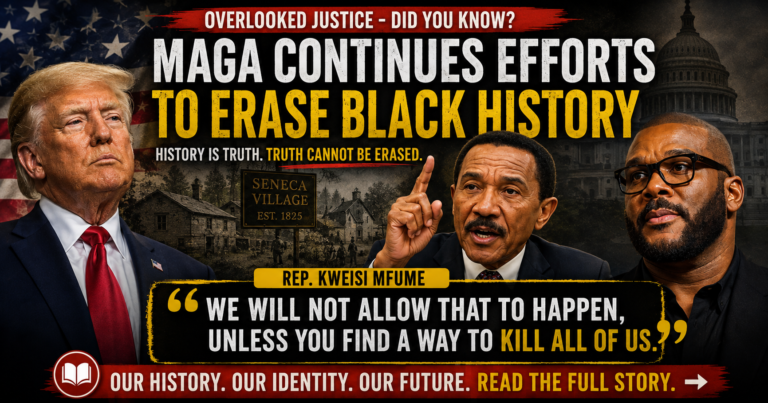
Representative Kweisi Mfume passionately defended preserving Black history during a recent congressional discussion, declaring:
“We will not allow that to happen, unless you find a way to kill all of us.”




Representative Jasmine Crockett has also publicly criticized efforts she believes undermine the teaching of Black history. Filmmaker Tyler Perry has likewise encouraged Black Americans to preserve their history, identity, and faith regardless of political or cultural pressures.
Watch: Rep. Kweisi Mfume
Watch: Tyler Perry – “Their Plan to Erase Our History Can Never Happen”
“The pride and ambition of man to conquer have never changed, and the evil of those who lead efforts to erase the greatness of God’s people will never prevail.” — IAMV
The formula of these efforts can be seen globally from many aspects of society, including the suppression of voices and attempts to diminish or erase Black history while continuing to profit from the historical enterprise of slavery and the contributions of God’s people to this day.
According to this perspective, tools are created to advance this agenda through limiting historical education, influencing public discourse through social media, news, and other platforms, and gradually removing the past from the collective memory of humanity. The result, supporters of this view argue, is that future generations lose knowledge of history while systems of inequality continue.
Those who are entrusted to protect the interests of all people and uphold justice are expected to govern equally under the law. Critics argue that laws and policies that disproportionately impact communities while protecting special interests contribute to censorship, unequal treatment, and forms of modern oppression.
Central Park’s Hidden History: Seneca Village
One of the lesser-known chapters of American history lies beneath one of the world’s most visited parks.
Before Central Park existed, the land was home to Seneca Village, a thriving community established in 1825 by free Black landowners. Historians recognize it as one of the most significant African American communities in nineteenth-century New York City.
The village became one of the largest concentrations of Black property owners in New York. At the time, property ownership also enabled many Black men to meet New York’s property requirements to vote.
Seneca Village included:
- Approximately 350 residents.
- Three churches.
- Two schools.
- Three cemeteries.
- A diverse community consisting primarily of Black residents, alongside Irish and German immigrants.
As New York City pursued construction of Central Park, officials exercised the power of eminent domain to acquire the land for public use. Residents challenged the action in court, but by 1857 the community had been dismantled, homes demolished, and families displaced.
Today, historians continue working to preserve and tell the story of Seneca Village as an important chapter in American history—one that reflects resilience, community, property ownership, and the ongoing importance of preserving historical truth for future generations.
Historical Reports That Received Limited Public Attention
Stories like this historical report often receive relatively little public attention compared to other online content.
One example is The Washington Post’s investigative database documenting members of Congress who owned enslaved people. The project identified more than 1,700 current and former members of Congress connected to slave ownership using historical records including census documents, wills, court records, newspapers, and other archival sources.
Watch: “Washington Post Creates Database Of Members Of Congress Who Owned Slaves”
At the time of this publication, the NBC News YouTube channel has approximately 12.1 million subscribers, while this report has received approximately 27,000 views, about 606 reactions, and roughly 405 comments, according to the public figures displayed on YouTube.
The level of engagement alone does not explain why a video receives more or fewer views, as many factors—including audience interest, recommendation systems, timing, and competing news events—can influence online reach.
Nevertheless, Overlooked Justice encourages readers to ask an important question:
How much attention do historically significant investigations receive compared to other forms of online content?
Use wisdom and knowledge to discern.
Commentary – Rise Beyond | IAMV
“The revelations of evil and greed are being revealed globally. God’s revelations continue to awaken us so that we may come together and not allow injustice and inhumane actions to lead humanity to a place of no return. Throughout history there have been attempts to silence voices, suppress truth, and erase the contributions and greatness of God’s people. Yet truth has always endured. History should be preserved—not hidden—so future generations may learn from both humanity’s failures and its triumphs. Justice begins with truth, and truth cannot remain buried forever.”
— Rise Beyond | IAMV