Some links on this page may be promotional or referral-based. Overlooked Justice may earn compensation from qualifying actions at no additional cost to you. Offers and availability are subject to third-party terms. Editorial integrity remains independent.
Six Days Past the Printed Freshness Date — A Neighborhood Pantry Distribution Raises Questions About Food Safety, Trust, and Tax Benefits
When a family needs food, generosity can be a lifeline.
Across America, neighborhood pantries, churches, volunteers, food banks, and businesses give their time and resources to help people struggling with job losses, rising grocery prices, and financial hardship.





Their heartfelt contributions matter, and those efforts deserve appreciation.
But needing assistance should never mean being expected to accept avoidable health risks.
Overlooked Justice is raising a question every donor, food pantry, public-health official, and recipient should be willing to answer:
Are donated foods receiving adequate safety screening before they are distributed to families who depend on neighborhood food assistance?
A Documented Pantry Distribution on October 27, 2026
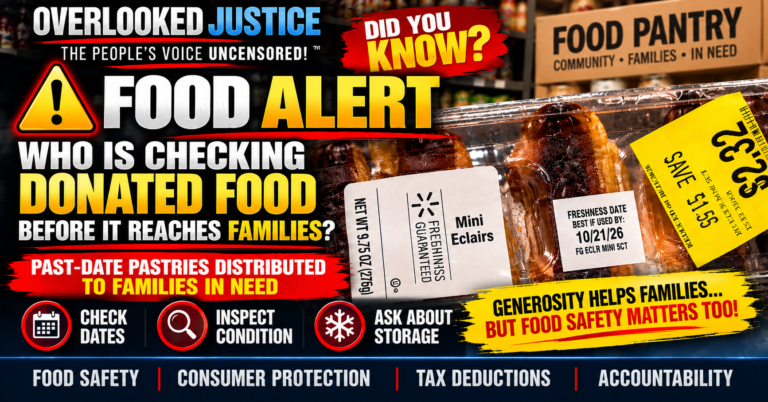
At approximately 12:20 p.m. on Tuesday, October 27, 2026, a recipient reports receiving a package of Walmart-branded Mini Éclairs from a neighborhood food pantry.
Photographs supplied to Overlooked Justice show the package marked:
“FRESHNESS DATE — BEST IF USED BY: 10/21/26.”
The printed freshness date had passed six days earlier.
The container also bears a yellow retail markdown sticker, raising questions about how the product moved from retail inventory into the food-assistance system.
However, the sticker does not establish who donated the pastries or when they were donated.
The photographs document the package and freshness date. The recipient’s firsthand account establishes the reported distribution time.
What remains unknown is how the pastries were stored, whether refrigeration or freezing was required and maintained, who supplied them, and what safety inspection occurred before distribution.
The evidence does not establish that the pastries were contaminated or that a law was broken.
But it does establish a legitimate reason to ask who examined the product before it reached a family.
A “Best If Used By” Date Is Not Automatically an Expiration Date
The U.S. Food and Drug Administration and USDA explain that a “best if used by” date generally identifies when a product is expected to maintain its best quality.
It does not automatically mean the food becomes unsafe the following day.
However, food safety cannot be determined by reading a date alone.
Cream-filled pastries can present additional concerns depending on their ingredients and storage requirements.
The FDA advises that donated cold foods requiring refrigeration be maintained at 41°F or below, with appropriate handling, transportation, and recordkeeping.
FoodSafety.gov advises discarding cream-filled pastries that have been exposed to temperatures above 40°F for more than two hours.
Whether this happened with the photographed package has not been established.
A donated product should not automatically be considered unsafe because its best-by date passed. But it should not automatically be considered safe simply because someone donated it.
That is why food-safety screening matters.
 FOOD WARNING BEFORE YOU EAT — WATCH & SHARE!
Before you take that first bite, know what you’re eating! Donated food can be a blessing, but your family’s health comes first. Check food labels, freshness dates, packaging, and storage requirements. Don’t assume food is safe simply because it was given to you. Stay informed, protect your family, and share this important warning with others!
 WATCH & SHARE THE VIDEO:
Families Already Facing Hardship Deserve More Than Unanswered Questions
Imagine losing your job, struggling to pay rent, watching grocery prices rise, and having to depend on food assistance to feed your children.
Now imagine discovering that some donated products are beyond their printed freshness dates without anyone explaining whether they were properly inspected.
How should consumers know what to trust?
According to the USDA, approximately 18.3 million American households experienced food insecurity at some point during 2024.
For families who have also lost health insurance or face significant medical expenses, a preventable foodborne illness can make an already difficult situation worse.
A person without reliable health coverage may hesitate to seek care because of the potential expense.
No American should have to choose between hunger and uncertainty about the safety of the food being placed on their table.
Food pantries provide an essential public service. Their mission is to relieve hardship, not expose families to additional uncertainty.
No family should feel embarrassed to ask whether food is safe. No volunteer should have to guess. And no food pantry should view questions about product safety as criticism of its generosity.
Trust is earned through transparency, responsible handling, and accountability—not simply good intentions.
Are Companies Receiving Tax Write-Offs for Donating Food?
This is another important part of the investigation.
Yes. Under federal law, qualifying businesses can receive charitable tax deductions for eligible food donations.
Internal Revenue Code Section 170(e)(3) provides an enhanced deduction for certain donations of apparently wholesome food to qualifying charitable organizations.
A tax deduction is different from a tax credit. The deduction is subject to eligibility, documentation, and other legal requirements.
The IRS recognizes that qualifying food may be less marketable because of age, freshness, appearance, or surplus inventory.
This creates an important question:
What procedures ensure that the financial benefits of food donations never take priority over the safety of the people receiving them?
Donating unsold inventory can reduce food waste while providing food to families who need it. That can be a responsible and valuable practice.
But food donation programs should never become a way to transfer potentially unsafe products to financially vulnerable consumers.
The photographs in this investigation do not establish that Walmart donated the pastries or received any deduction. The original donor and any related tax treatment remain unverified.
Nevertheless, the broader issue deserves examination.
A charitable tax benefit should never be treated as a substitute for responsible food-safety practices.
This Concern Extends Beyond One Neighborhood Pantry
In November 2025, Action News 5 in Memphis, Tennessee, investigated questions about chicken distributed through a food pantry with a best-by date approximately one year earlier.
The food bank explained that the chicken had been frozen and described procedures intended to preserve its safety.
That situation illustrates why proper storage and handling are just as important as printed dates.
A 2025 study of 84 food pantries in central and eastern North Carolina found that 87% reported having a policy governing how long products could be distributed beyond printed dates.
These findings demonstrate that many organizations recognize the need for procedures addressing past-date foods.
The real question is whether those procedures are followed consistently and communicated clearly to recipients.
What Consumers Should Check Before Eating Donated Food
Families receiving food assistance should remain cautious without assuming that every past-date item is dangerous.
- Check the label. Read the best-by or use-by date, ingredients, allergen warnings, and refrigeration instructions.
- Ask how perishable food was stored. Refrigerated products should be handled according to food-safety temperature requirements.
- Inspect packaging. Avoid damaged, leaking, opened, moldy, or visibly spoiled products. Some contaminated food may look and smell normal.
- Do not gamble with uncertain food safety. If a perishable product’s handling or storage history is questionable, request a replacement rather than taking an unnecessary risk.
- Document concerning products. Photograph the packaging and labels, preserve the distribution details, and contact the pantry or appropriate food-safety authority.
 NATIONAL CONSUMER FOOD SAFETY ALERT — KNOW WHERE TO REPORT CONCERNS
Food pantries operate throughout the United States, providing assistance to millions of families, seniors, children, veterans, and individuals experiencing financial hardship.
Food assistance should never mean sacrificing food safety.
Overlooked Justice encourages consumers nationwide to examine food packaging, check printed dates, follow storage instructions, and report concerns about questionable food products or unsafe food handling.
WHERE CONSUMERS NATIONWIDE CAN REPORT FOOD SAFETY CONCERNS
1. U.S. Food and Drug Administration (FDA)
For complaints involving seafood, baked goods, produce, dairy products, and most other FDA-regulated foods:
National Hotline: 1-888-723-3366 (1-888-SAFEFOOD)
Website: https://www.fda.gov
2. U.S. Department of Agriculture (USDA)
For complaints involving USDA-regulated meat, poultry, and processed egg products:
National Hotline: 1-888-674-6854
Website: https://www.fsis.usda.gov
3. State and Local Food Safety Authorities — All 50 States
Consumers concerned about food pantry sanitation, improper storage, refrigeration, distribution practices, or suspected foodborne illness should contact their appropriate state or local health department or food safety agency.
National Reporting Directory:
https://www.foodsafety.gov/food-poisoning/report-problem-with-food
WHAT CONSUMERS SHOULD DOCUMENT
When reporting concerns about food received from a pantry or charitable distribution program, consumers should document:
- The name and location of the food distribution organization.
- The date the food was received.
- Photographs of the food and packaging.
- Printed dates, lot numbers, and product identification codes.
- Evidence of damaged packaging, improper refrigeration, or questionable food conditions.
- Any illness or symptoms suspected to be associated with the food.
A printed date alone does not necessarily mean a food product is expired or unsafe. Consumers should also consider storage conditions, product labeling, and available manufacturer guidance.
Families receiving donated food deserve the same food safety protections as families purchasing groceries.
Every food pantry, charitable organization, distributor, and participating supplier has a responsibility to follow applicable food safety requirements and protect the people they serve.
When Americans depend on food assistance for survival, who is ensuring the food they receive has been properly stored, inspected, handled, and distributed?
Overlooked Justice encourages consumers across all 50 states to remain informed, document concerns, and report potential food safety problems to the appropriate authorities.
Questions That Food Pantries, Donors, and Regulators Should Answer
Overlooked Justice believes the following questions deserve attention.
Who originally supplies donated foods?
Are all donations inspected when received?
Who checks freshness dates and refrigeration requirements?
Are refrigeration and transportation temperatures documented?
Are volunteers trained to identify products that should not be distributed?
Are recipients advised when products have passed printed quality dates?
Are businesses claiming charitable deductions maintaining the required donation records?
And most importantly:
When a family raises a concern about donated food, who takes responsibility for providing an answer?
These questions concern the entire food donation and distribution system, not an assumption that a particular organization acted improperly.
IAMV Perspective: Generosity Must Never Come at the Expense of Human Dignity
We sincerely appreciate the generosity of every individual, community organization, church, food pantry, and business working to feed struggling families.
We recognize that thousands of volunteers give their time and energy without expecting anything in return.
Their contributions represent compassion and humanity at a time when many families desperately need both.
But compassion must always be accompanied by responsibility.
Families receiving donated food deserve the same consideration for health and safety as families purchasing groceries at full price.
Their financial circumstances should never determine the quality of the protection they receive.
And when families are already confronting unemployment, inflation, or the loss of medical coverage, an avoidable illness can become a devastating financial and personal hardship.
How can consumers know whom to trust?
By expecting transparency.
By asking questions.
By supporting responsible donors and organizations that maintain strong food-safety procedures.
And by refusing to accept the idea that financial hardship means consumers should lower their expectations for their own health and well-being.
Food insecurity must never become an excuse for lower safety standards.
Tax advantages must never become a reason to pass questionable products along to vulnerable families.
Generosity should protect human dignity—not compromise it.
We want food donation programs to succeed. We want businesses to continue helping. We want volunteers to receive the resources and training they need.
And above all, we want families to receive assistance they can trust.
READ. CHECK. ASK QUESTIONS. PROTECT YOUR FAMILY. SHARE THIS FOOD ALERT.
 OVERLOOKED JUSTICE — THE PEOPLE’S VOICE UNCENSORED!
https://overlookedjustice.com/
Sources and Consumer Resources
FDA — Key Steps for Donating Food:
FDA — Surplus, Salvaged, and Donated Foods:
https://www.fda.gov/food/buy-store-serve-safe-food/surplus-salvaged-and-donated-foods
USDA — Food Security Statistics:
IRS — Publication 526, Food Inventory Donations:
https://www.irs.gov/publications/p526
NC State Extension — Food Pantries and Food Banks:
https://foodsafety.ces.ncsu.edu/community-food-safety/food-pantries-and-food-banks/
North Carolina Pantry Study:
https://pmc.ncbi.nlm.nih.gov/articles/PMC11819998/
FoodSafety.gov — Food Safety Charts:
https://www.foodsafety.gov/food-safety-charts/food-safety-during-power-outage
Action News 5 — November 2025 Pantry Report:
https://www.actionnews5.com/2025/11/23/how-why-food-pantries-deliver-meats-past-their-sell-by-date/
North Carolina Food Complaints:
https://www.ncagr.gov/divisions/food-drug-protection/food-drug-consumer-complaints