
Some links on this page may be promotional or referral-based. Overlooked Justice may earn compensation from qualifying actions at no additional cost to you. Offers and availability are subject to third-party terms. Editorial integrity remains independent.
“The agendas built in darkness, God will bring to light. The wrath upon our country is self-inflicted by evil and greed—while war, the disruption of civil liberties in the United States, and the killing of innocent children are used to camouflage the Epstein files. God’s promise is before us all.”
—IAMV
Revelation 18:4 ESV
“Come out of her, my people, lest you take part in her sins, lest you share in her plagues.”





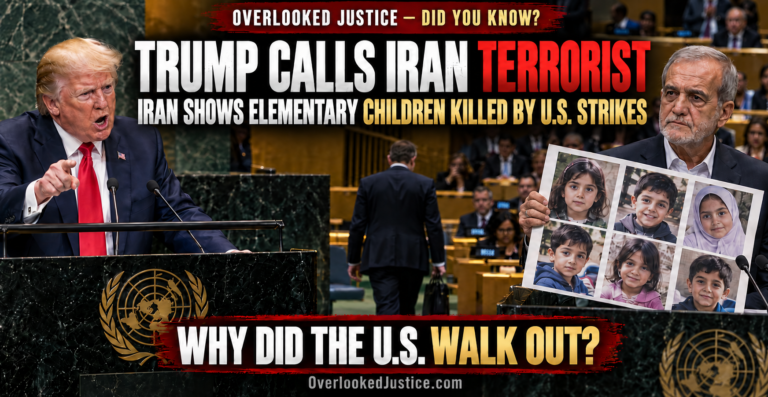
At the United Nations, President Donald Trump defended America’s military campaign against Iran, portrayed the Iranian government as a terrorist regime and warned Tehran of even greater consequences if it refused his demands.
But when Iranian President Masoud Pezeshkian addressed the same international body, he presented the other side of the war—the faces of Iranian children, teachers and civilians killed during U.S. military strikes.
As Pezeshkian displayed their photographs and rejected Trump’s description of Iran as the terrorist, a United States delegate rose and walked out.
The walkout created a powerful and disturbing image: a representative of the country responsible for the military campaign leaving the room as the reported civilian consequences of that campaign were placed before the world.
What Happened Inside the United Nations?
Pezeshkian accused the United States of attacking a sports facility where children were playing and killing Iranian scientists, women and children.
He directly challenged the American government’s labeling of Iran, declaring that those responsible for terrorism were describing Iran as terrorist. He maintained that Iran had defended itself and was not the aggressor portrayed by the United States.
The American representative walked out during those remarks. Reports indicate that the U.S. and Israeli seats were empty during portions of Pezeshkian’s address.
There is also an important distinction between the two walkouts:
- Most members of the Iranian delegation walked out while Trump defended U.S. military action against Iran.
- A U.S. delegate walked out while Iran’s president discussed the children and other civilians killed in American strikes.
These were separate demonstrations during separate speeches—but together they revealed how far the two countries remain from accountability, diplomacy and peace.
The Children Were Not Merely Political Props
The deaths presented by Pezeshkian cannot simply be dismissed as Iranian propaganda.
A United Nations fact-finding mission reported that it had reasonable grounds to believe the United States was responsible for strikes against the Shajareh Tayyebeh Primary School in Minab and a sports facility in Lamerd.
The mission concluded that the attacks may constitute war crimes because the United States allegedly failed to establish that the locations were legitimate military targets before striking them.
The school attack reportedly killed more than 150 people, including approximately 120 children. Another strike on the sports facility reportedly killed 22 civilians.
A preliminary U.S. military investigation reportedly found that outdated intelligence may have contributed to the school being attacked. The Pentagon has said its investigation remains ongoing.
Iran must also answer for its own conduct.
The same United Nations investigation accused Iranian authorities of crimes against humanity connected to the government’s violent suppression of protests, including allegations of unlawful killings, torture and arbitrary detention.
Overlooked Justice is not declaring either government innocent. The evidence demands accountability from both.
But one government’s abuses cannot erase innocent children killed by another government’s weapons.
America’s Allies Are No Longer Waiting for Trump to Leave
This confrontation comes as another major international story is developing: longtime American allies appear to be making permanent plans for a world in which the United States is no longer considered consistently dependable.
A report shared through NewsBreak under the title “America’s Allies Are No Longer Waiting for Trump to Leave” argues that allied governments once treated Trump’s policies as a temporary disruption.
Many now believe American isolationism and protectionism may continue beyond Trump—regardless of who occupies the White House after him.
These countries are responding by:
- Expanding their own military capabilities.
- Developing domestic defense industries.
- Diversifying international trade.
- Establishing partnerships that do not depend upon Washington.
- Reducing their exposure to future American tariffs and political reversals.
- Building closer relationships with Europe, Canada, India and, in some circumstances, China.
This is not necessarily an organized international revolt against the United States. Most allies still consider America an essential economic and security partner.
However, they increasingly appear unwilling to place their countries’ futures entirely in America’s hands.
Supporting story:
https://share.newsbreak.com/jo4ztkyf
Canada Is Building Relationships Beyond the United States
Canada offers one of the clearest examples.
Following repeated tariff threats and Trump’s statements suggesting that Canada should become part of the United States, Canadian Prime Minister Mark Carney began openly promoting greater cooperation among “middle powers.”
Carney traveled to China and announced a new strategic partnership involving trade, energy and agriculture. Canada has also moved toward deeper economic, technological and security cooperation with Europe.
European Commission President Ursula von der Leyen proposed exploring an “associate member” relationship between Canada and the European Union—an unprecedented idea that could bring Canada closer to Europe economically and strategically.
Trump responded by threatening the European Union with serious tariffs if he considered the proposal hostile.
Carney answered that no outside government would dictate Canada’s culture or determine with whom Canada could enter international agreements.
That exchange revealed something larger than a disagreement over tariffs: one of America’s closest neighbors is actively building protection against excessive dependence on the United States.
Europe Is Preparing to Defend Itself
Europe is also accelerating plans to assume responsibilities historically carried by Washington.
European leaders have proposed:
- A European Security Council involving the European Union, the United Kingdom, Canada and Norway.
- Expanded European missile-defense and military-satellite capabilities.
- Increased weapons manufacturing inside Europe.
- Greater European control of NATO’s conventional defense.
- Long-term security funding for Ukraine without depending principally on the United States.
European allies and Canada increased investments in core defense requirements by more than $139 billion in 2025. NATO members also announced more than $50 billion in new procurement and manufacturing commitments during the 2026 Ankara summit.
The Trump administration presents this as an achievement: allies are finally paying more for their own defense and reducing the financial burden placed upon American taxpayers.
That argument has merit. A stronger and more self-sufficient Europe does not automatically mean a weaker America.
But there is another side to the story: countries developing military independence because they no longer trust Washington may eventually stop seeking American leadership altogether.
Trade Relationships Are Also Being Rebuilt
The international realignment extends beyond military defense.
The European Union and India completed a massive trade agreement covering a combined market of approximately two billion people. The agreement followed years of negotiations, but growing American protectionism and international instability reportedly added urgency to the deal.
The European Union has also pursued expanded agreements with Canada, Mercosur, Indonesia and other international partners.
Every new relationship does not represent hostility toward America. Countries naturally diversify their trade.
But when America repeatedly uses tariffs as a threat—even against close allies—those allies have a powerful incentive to create markets and supply chains that Washington cannot interrupt.
The Cost of “America First”
Supporters of Trump argue that his approach forces other countries to stop taking advantage of the United States, contribute more toward their own defense and negotiate fairer trade relationships.
Critics see a much more dangerous result: America may win individual confrontations while gradually losing the trust and influence accumulated across generations.
Both developments can occur simultaneously.
Trump may succeed in forcing NATO countries to spend more on defense. Those same countries may use their new capabilities to become less dependent upon—and less responsive to—the United States.
Tariffs may produce concessions in the short term. They may also encourage foreign governments to redesign their economies so they no longer require the American market.
Military force may weaken an adversary. Civilian deaths, contested intelligence and disputed legal justifications may simultaneously weaken America’s moral authority.
What Is Being Hidden Behind War?
The American people are being pulled from one crisis to another.
War dominates the headlines. Civil liberties are disrupted. Political divisions grow deeper. Innocent children are killed. Foreign governments are labeled as terrorists while questions concerning America’s own actions remain unanswered.
At the same time, demands for the complete release of the Epstein files continue.
Who participated?
Who was protected?
What information remains hidden?
Why has full accountability still not reached the American people?
War should never become a convenient curtain behind which unanswered questions, political corruption or crimes committed by powerful individuals disappear from public attention.
The American people can care about national security while continuing to demand the complete truth about the Epstein files.
One crisis must not be allowed to camouflage another.
IAMV Perspective
A nation cannot demand that the world condemn terrorism while refusing to remain in the room when the faces of children killed by its own weapons are displayed.
Walking out does not disprove the allegations.
Calling another government terrorist does not automatically make every American military target legitimate.
Iran must be held accountable for any attacks, repression, torture or killings committed by its government. But the United States must be held to the same standard it demands of everyone else.
The central issue is larger than Trump or Iran.
What happens when America’s allies stop believing that the next election will restore stability? What happens when they conclude that American unpredictability is no longer temporary—but a permanent risk that must be managed?
America’s power has never come from military force alone. It has also come from trust, alliances, economic relationships and the belief that the United States would defend principles extending beyond its immediate interests.
Once that trust disappears, it cannot be restored by threats.
It cannot be restored by tariffs.
It cannot be restored by walking out of the room.
The faces of the dead remain—even after the delegates are gone. May God bless the souls of the children killed by evil and greed. 
Questions the People Deserve to Ask
- Who approved the intelligence used to target the Iranian school and sports facility?
- Were those locations properly verified as military targets?
- Will the complete U.S. investigation be released publicly?
- Will anyone be held responsible if outdated or inadequate intelligence killed children?
- Why did the American delegate walk out instead of remaining to hear and answer the accusations?
- Are America’s allies becoming stronger partners—or preparing for a future without American leadership?
- Can the United States continue demanding international accountability while resisting accountability for its own actions?
- Is war distracting the public from the full release of the Epstein files?
- When both sides call the other terrorist, who speaks for the innocent civilians trapped between them?
Watch the United Nations Confrontation
Iranian President Masoud Pezeshkian shows the faces of children and teachers reportedly killed during U.S. strikes as the American delegate walks out:
Supporting Reports
America’s Allies Are No Longer Waiting for Trump to Leave:
https://share.newsbreak.com/jo4ztkyf
United Nations findings concerning the strikes in Iran:
https://www.reuters.com/world/middle-east/un-mission-finds-grounds-believe-us-committed-war-crimes-iran-tehran-crimes-2026-09-17/
Canada and Europe’s developing alliance:
https://www.reuters.com/world/americas/trump-warns-eu-tariffs-over-canadas-potential-associate-membership-calls-it-2026-09-17/
The Faces of Innocent Children Must Never Become Collateral Damage—or Be Forgotten When the Cameras Move On
The People’s Voice. Uncensored.
—IAMV