Some links on this page may be promotional or referral-based. Overlooked Justice may earn compensation from qualifying actions at no additional cost to you. Offers and availability are subject to third-party terms. Editorial integrity remains independent.
DO YOU REALLY KNOW WHERE THE MEAT YOU ARE BUYING CAME FROM?
You walk into a grocery store.
You pick up a package of ground beef, sausage or another meat product.




You see:
USDA INSPECTED
U.S. INSPECTED AND PASSED
A U.S. company name.
Maybe even an American city and state on the package.
So what does that mean?
Does it mean the animal was born and raised in the United States?
Not necessarily.
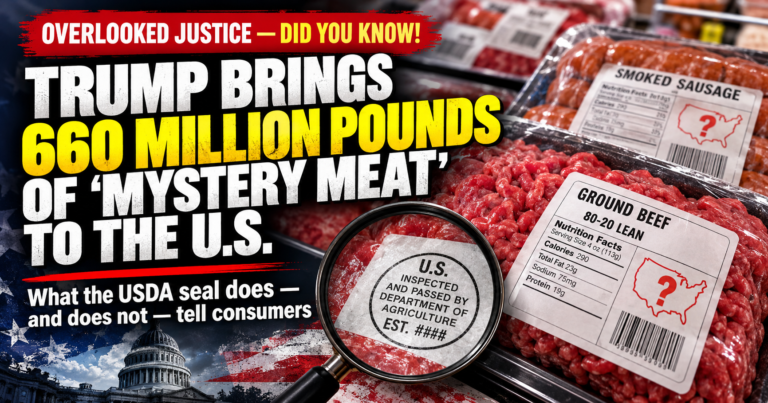
And with the federal government authorizing hundreds of millions of pounds of additional imported lean beef trimmings in 2026, understanding what meat labels actually tell consumers has become increasingly important.
WHAT HAPPENED WITH THE 660 MILLION POUNDS?
On August 26, 2026, President Donald Trump issued a proclamation temporarily increasing the quantity of lean beef trimmings eligible to enter the United States under the lower in-quota tariff rate by 300,000 metric tons.
That equals approximately 661 million pounds.
The additional quota was divided into three 100,000-metric-ton periods beginning September 1, October 1 and October 31, 2026. The White House says the additional quantity applies specifically to lean beef trimmings and is intended to help increase supply available for ground beef.
Important:
This does not mean 661 million pounds of steaks suddenly appeared in American supermarkets.
It means the administration authorized approximately 661 million additional pounds of qualifying lean beef trimmings to enter under the lower in-quota tariff rate during the specified period.
The proclamation itself says the additional quantity applies to “lean beef trimmings.”
White House Proclamation:
WHY ARE PEOPLE CALLING IT “MYSTERY MEAT”?
“Mystery meat” is not an official USDA term.
The phrase was used by investigative journalist and Fast Food Nation author Eric Schlosser in a September 7, 2026 opinion piece titled:
“Why Did Trump Order Up 660 Million Pounds of Mystery Meat?”
Schlosser’s article raised concerns about how easily consumers can identify where imported beef originated after it enters the U.S. food system and is used in products such as ground beef.
Related story:
https://www.nytimes.com/2026/09/07/opinion/trump-meat-import.html
That brings Overlooked Justice to an important consumer question:
DOES A USDA SEAL MEAN YOUR MEAT CAME FROM AN ANIMAL RAISED IN THE UNITED STATES?
The answer is:
NOT NECESSARILY.
USDA INSPECTED DOES NOT MEAN U.S.-RAISED
A USDA inspection mark is important.
It provides information about federal inspection and the establishment responsible for producing or handling the meat.
But a USDA inspection mark does not, by itself, tell you:
Where the animal was born.
Where it was raised.
Or whether it spent its entire life in the United States.
A USDA inspection statement and a country-of-origin statement answer different questions.
That distinction matters.
BEEF ONCE HAD MANDATORY COUNTRY-OF-ORIGIN LABELING
Many consumers may not realize that beef and pork were once included under federal mandatory Country of Origin Labeling requirements — commonly called COOL.
That changed.
USDA confirms that mandatory COOL requirements were removed for:
Beef muscle cuts
Pork muscle cuts
Ground beef
Ground pork
The final rule became effective March 2, 2016.
USDA source:
That means consumers buying ground beef today cannot simply assume that a retail package must tell them where the cattle were born or raised.
USDA inspection and mandatory retail country-of-origin labeling are not the same thing.
OVERLOOKED JUSTICE REVIEWED REAL CONSUMER EXAMPLES
Overlooked Justice reviewed actual meat products as examples of what consumers may encounter when shopping.
One example was:
CIRCLE A BRAND 80/20 GROUND BEEF
The product labeling included the statement:
“This product was prepared from inspected and passed meat and/or poultry.”
That tells the consumer something important about inspection.
But now ask another question:
Does that statement tell you where the cattle were born?
No.
Does it tell you where they were raised?
No.
Does “inspected and passed” automatically mean American-raised beef?
No.
That is where consumers need to understand exactly what the wording means rather than assume it means more than the package actually says.
The point is not simply to examine Circle A.
The point is for consumers to begin examining the meat they are buying themselves.
Turn the package over.
Read it.
Research it.
Understand what the terminology means.
ANOTHER CONSUMER EXAMPLE — RED ROSE SAUSAGE
Overlooked Justice also reviewed:
RED ROSE IMITATION SMOKED SAUSAGE
The product identifies itself as:
“U.S. Inspected and Passed by Department of Agriculture.”
It also identifies:
Polk’s Meat Products, Inc.
Magee, Mississippi.
Think about what the average shopper sees:
A U.S. Department of Agriculture inspection statement.
An American company.
A Mississippi address.
It would be understandable for someone to assume the animals supplying the meat were therefore raised in the United States.
But those facts alone do not establish where the animals were born or raised.
PACKED IN AMERICA DOES NOT AUTOMATICALLY MEAN RAISED IN AMERICA.
PROCESSED IN AMERICA DOES NOT AUTOMATICALLY MEAN RAISED IN AMERICA.
USDA INSPECTED DOES NOT AUTOMATICALLY MEAN U.S.-RAISED.
WHAT ABOUT IMPORTED MEAT — IS IT INSPECTED?
Yes.
This story should not be interpreted to mean imported beef simply enters the United States without food-safety controls.
Imported meat is subject to federal requirements before it can enter U.S. commerce.
The larger consumer issue here is not whether all imported beef is unsafe.
The issue is understanding what the label actually tells you about origin.
A product can satisfy inspection requirements without the USDA inspection mark itself telling you where the animal was born and raised.
WHAT DOES “PRODUCT OF USA” MEAN NOW?
There has been an important change consumers should know about.
Beginning January 1, 2026, USDA’s updated rules apply to voluntary U.S.-origin claims such as:
Product of USA
Made in the USA
For qualifying single-ingredient FSIS-regulated products using those claims, USDA requires that the product come from animals that were:
Born in the United States
Raised in the United States
Slaughtered in the United States
Processed in the United States.
USDA source:
That is substantially different from simply seeing a USDA inspection mark.
BUT HERE IS SOMETHING ELSE CONSUMERS NEED TO UNDERSTAND
“Product of USA” and “Made in the USA” are voluntary claims.
USDA says those claims are not required to appear on meat labels.
So consumers should not automatically conclude meat is foreign because the words “Product of USA” are absent.
But the opposite is also true:
You should not assume meat is U.S.-raised simply because a USDA inspection statement and an American company address are present.
If origin matters to you, investigate further.
WHY THE 660 MILLION POUNDS MAKES THIS IMPORTANT
The White House says the additional quota applies specifically to lean beef trimmings used to help supply the ground-beef market.
At the same time, ground beef is no longer covered by the federal mandatory COOL requirements that previously applied to it.
Put those facts together from a consumer-information standpoint:
Hundreds of millions of pounds of additional foreign lean beef trimmings have been authorized under the temporary expansion.
Those trimmings can be used in ground beef.
Ground beef is no longer subject to the former federal mandatory country-of-origin labeling requirement.
And a USDA inspection mark alone does not establish where the cattle were raised.
That is why consumers need to understand the difference between:
INSPECTED
PACKED
PROCESSED
DISTRIBUTED
PRODUCT OF USA
BORN IN THE USA
RAISED IN THE USA
Those phrases do not all mean the same thing.
BEFORE YOU PUT IT IN YOUR CART — READ IT
The next time you buy meat, don’t simply look at the price and the front of the package.
Turn it over.
Read the entire label.
Look for:
The USDA inspection mark.
The USDA establishment number.
The company that processed or packed the meat.
Where it was processed or packed.
Any country-of-origin information.
“Product of USA.”
“Made in the USA.”
Statements identifying where the animal was born.
Statements identifying where the animal was raised.
Statements identifying where the animal was slaughtered or processed.
Then ask yourself:
DOES THIS PACKAGE ACTUALLY SAY THE ANIMAL WAS RAISED IN AMERICA?
Or did you assume that because you saw a USDA inspection statement and an American company address?
DO YOUR OWN RESEARCH
If knowing where your meat came from matters to you, research it.
Look up the company.
Look up the USDA establishment number.
Research the brand.
Read the manufacturer’s sourcing information.
Ask your grocery store.
Contact the processor.
Do not assume:
U.S. inspected = U.S.-raised.
U.S. packed = U.S.-raised.
American company = American-raised animal.
Those things may all be true for a particular product.
But the words themselves do not automatically establish it.
WATCH THIS VIDEO REPORT
Now that you understand the difference between USDA inspection, processing and where an animal was actually raised, watch this report concerning the approximately 660 million pounds of additional foreign lean beef trimmings authorized for the United States:
Then ask yourself:
DO YOU ACTUALLY KNOW WHERE THE MEAT YOU ARE FEEDING YOUR FAMILY WAS RAISED?
RELATED STORY
Why Did Trump Order Up 660 Million Pounds of Mystery Meat?
The New York Times — Eric Schlosser
https://www.nytimes.com/2026/09/07/opinion/trump-meat-import.html
Additional interview with Eric Schlosser:
Democracy Now! — “Fast Food Nation,” Mystery Meat & Trump’s Dismantling of U.S. Food Safety System
https://www.democracynow.org/2026/9/17/mystery_meat
Schlosser’s “mystery meat” description and concerns are his analysis and characterization; “mystery meat” is not a USDA classification.
IAMV PERSPECTIVE
Most Americans do not have time to stand in a grocery store and read federal regulations before deciding what to put into their shopping carts.
They look at the package.
They see the USDA seal.
They see an American company name.
They see an American city and state.
And many may naturally assume:
This is American meat from an animal raised in America.
But consumers need to understand that those labels may be describing inspection, processing or packing — not necessarily where the animal lived before becoming the meat sitting in front of them.
Now the federal government has authorized approximately 661 million pounds of additional foreign lean beef trimmings under a temporary expansion of the lower tariff-rate quota.
At the same time, mandatory federal country-of-origin labeling for beef and ground beef was removed years ago.
That does not tell you imported beef is bad.
It does not tell you U.S.-raised beef is better.
It tells you something much more basic:
KNOW WHAT YOU ARE BUYING.
If you prefer American-raised beef, know what wording to look for.
If you are comfortable purchasing imported beef, that is your decision.
But consumers should be making that decision with information — not because an inspection seal or an American address caused them to believe something the package never actually said.
Read the label.
Research the product.
Understand the USDA seal.
Understand the establishment number.
Understand where “packed,” “processed,” “inspected,” “Product of USA,” and “raised in the USA” differ.
The package may tell you more than you previously noticed.
And sometimes it may tell you less than you assumed.