Some links on this page may be promotional or referral-based. Overlooked Justice may earn compensation from qualifying actions at no additional cost to you. Offers and availability are subject to third-party terms. Editorial integrity remains independent.
The illusions before the people that say, “No one is above the law,” do not apply to those creating laws to validate their crimes or sins. This is not as much about the individual as it is about the unbalanced rule of law that many have lost trust in—and why it needs restructuring to serve and protect against the lawlessness in governing that has destroyed the rights of its citizens.
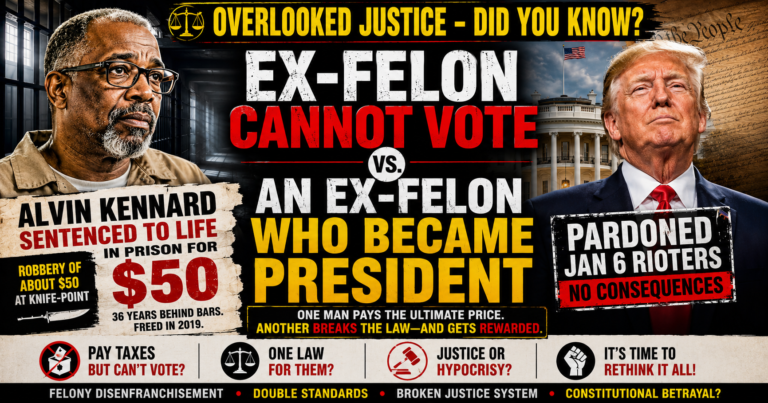
Denying tax-paying citizens with a felony conviction the right to vote is legal under federal law, even though it appears to contradict the principle of “no taxation without representation.”
The legality of this practice, known as felony disenfranchisement, is rooted in the text of the U.S. Constitution and decades of legal precedent.





The Constitutional Basis
The primary reason felony disenfranchisement is legal is Section 2 of the Fourteenth Amendment. While the Constitution generally protects voting rights, this specific section allows states to deny or abridge a citizen’s right to vote for “participation in rebellion, or other crime.”
In the landmark 1974 case Richardson v. Ramirez, the U.S. Supreme Court ruled that this constitutional language gives states an “affirmative sanction” to strip voting rights from individuals convicted of felonies. Because the restriction is explicitly written into the Constitution, the Supreme Court determined it does not violate the Equal Protection Clause.
https://supreme.justia.com/cases/federal/us/418/24
The Argument for Legality
Proponents of these laws argue that voting is a civic privilege tied to a responsibility to follow society’s rules. Under this framework, committing a serious crime—a felony—represents a breach of the social contract. Consequently, states maintain the authority to determine that those who break the laws should temporarily or permanently lose their say in making them.
The Intersection with Taxes
The concept of “no taxation without representation” is a foundational political slogan from the American Revolution, but it is not an enforceable constitutional right.
Universal Tax Obligations: The federal government and state governments require all individuals who earn income, own property, or buy goods to pay taxes, regardless of their legal status, age, or eligibility to vote. For example, resident green card holders and minors also pay taxes but cannot vote.
No Exemption: The judicial system has consistently ruled that a loss of civil rights does not exempt an individual from their financial obligations to the government.
The Debate and Shifting State Laws
Critics argue that denying the vote to tax-paying, rehabilitated citizens is undemocratic, counterproductive to reintegration, and disproportionately impacts communities of color.
Because the U.S. Constitution leaves voting qualifications up to individual states, the law varies dramatically across the country:
No Disenfranchisement: In Maine and Vermont, individuals with felony convictions never lose their right to vote, even while incarcerated.
Automatic Restoration: In many states, voting rights are automatically restored immediately upon release from prison or after completing parole and probation.
Financial Requirements: Some states require individuals to pay off all court-ordered fines, fees, and restitution before they can vote again—a practice critics compare to a modern-day poll tax.
Permanent Ban: In a few states, certain felony convictions result in a lifetime ban on voting unless the individual receives a specific governor’s pardon.
Alvin Kennard was an Alabama man sentenced to life in prison without parole in 1983 for robbing a bakery of about $50 at knife-point. Under Alabama’s strict “three strikes” habitual offender law at the time, his prior property crimes triggered the mandatory life sentence. He was resentenced and freed in 2019 after serving 36 years.
Did You Know? Federal law enforcement officers—including FBI agents—are legally permitted to lie, but there is a major double standard because it is a federal felony for you to lie to them.
The legal framework regarding how deception is managed between citizens and federal agents highlights critical boundaries to be aware of:
 The Double Standard Under Federal Law
Agents can lie to you: Decades of court rulings, including the landmark U.S. Supreme Court case Frazier v. Cupp, establish that law enforcement can use trickery and deception.
You cannot lie to agents: Under 18 U.S. Code § 1001, making a materially false, fictitious, or fraudulent statement to a federal agent is a felony punishable by up to five years in federal prison. You do not have to be under oath to violate this statute.
 Permissible Deception by FBI Agents
During interviews or interrogations, agents are legally allowed to utilize specific deceptive tactics to elicit confessions or information:
Fabricating evidence: Agents can falsely claim they found your DNA, fingerprints, or phone records at a crime scene.
Misrepresenting witness statements: They can lie and tell you that a co-defendant or friend has already confessed and implicated you.
Minimizing the situation: Agents can tell you the discussion is “just routine” or “no big deal” to make you let your guard down.
Offering false sympathy: They can pretend to be on your side or claim that “honesty will make things go better,” even though only prosecutors decide on plea deals.
 What FBI Agents Are NOT Allowed to Do
The law does place strict limits on deceptive tactics. Courts will throw out a confession if the deception crosses the line into unconstitutional coercion that overrides a suspect’s free will:
Forging official documents: They cannot manufacture fake government records, such as a fake warrant or fabricated lab results.
Making false legal promises: They cannot promise formal leniency or immunity, as only federal prosecutors hold that authority.
Deprivation and coercion: They cannot use physical threats, torture, or deny you food, water, or sleep to force a confession.
Lying about legal rights: They cannot falsely tell you that your lawyer has abandoned you or misrepresent your core constitutional rights.
Because of this legal landscape, civil rights organizations like the ACLU emphasize that if you are approached by federal agents, your safest legal recourse is to completely refrain from trying to outsmart them; instead, explicitly invoke your Fifth Amendment right to remain silent and ask for an attorney immediately.
If you are looking into this because of a specific situation, let me know if you need information on how to properly invoke your rights, what to do if agents show up at your house, or how federal courts evaluate involuntary confessions.
The People who seem Always Fit the Description: Crooked Cops Arrest FBI Agent
President Donald Trump Pardons Jan. 6 Rioters – Listen Closely:
The Constitution that was meant to protect all people—yet police seem to govern brown people under a modernized version of the Black Codes, continuing the legacy of slavery.
“There is not a politician alive who can truly be trusted, and the Constitution is dead.” — IAMV