Some links on this page may be promotional or referral-based. Overlooked Justice may earn compensation from qualifying actions at no additional cost to you. Offers and availability are subject to third-party terms. Editorial integrity remains independent.
WHY WE NEED INDEPENDENT MEDIA — TO DROWN OUT THE PROGRAMMING!
OVERLOOKED JUSTICE INVESTIGATIVE REPORT
🚨 WHEN A TECH GIANT BECOMES THE GATEKEEPER
Imagine starting a business, selecting a telephone service, providing your payment information, and then being told that you must surrender additional personal identification before you can use the service.





You comply.
You submit your government-issued identification. You submit financial documents. Your payment card is recognized, and a payment authorization appears on your account.
Then Google tells you:
“The document could not be verified.”
No meaningful explanation. No identification of the specific problem. No immediate resolution.
You submit additional documentation, only to receive the same rejection.
WHO DECIDES WHETHER YOUR BUSINESS GETS TO OPERATE — YOU OR THE CORPORATION CONTROLLING ACCESS TO THE SERVICE?
I’m examining that question following a documented November 21, 2026, Google Workspace Telecom signup experience.
Overlooked Justice has the full story and supporting documents, including verification correspondence, rejection notices, screenshots, account-status information, and additional documentation. The customer’s identity and business name are being withheld to protect their privacy.
🎥 THREE YEARS EARLIER — I CALLED GOOGLE MYSELF!
GOOGLE — ALL PROFITABILITY AND NO ACCOUNTABILITY!
This is not the first time I have raised concerns about Google’s treatment of paying customers.
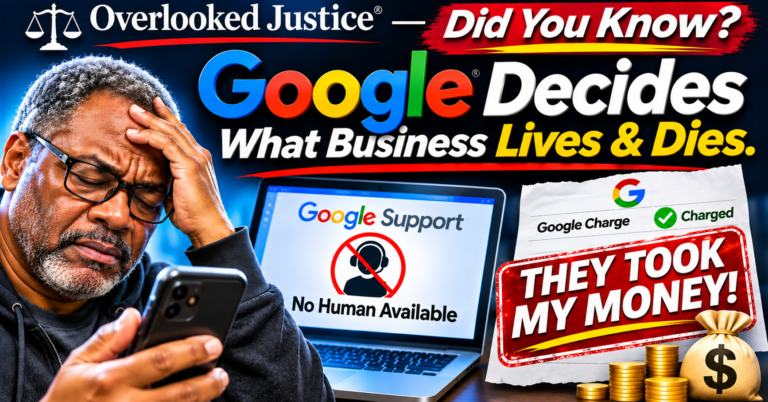
Approximately three years ago, during the period of federal antitrust proceedings involving Google and the United States Department of Justice, I personally contacted Google’s customer service regarding money Google charged me for a service that was never properly delivered or resolved.
Three years later, Google still has not provided the assistance or resolution I sought, nor returned my money.
I recorded that experience and made it available publicly.
🎥 WATCH MY VIDEO — GOOGLE CUSTOMER SERVICE CALL
PAY PARTICULAR ATTENTION AT 6:03.
At approximately 6 minutes and 3 seconds into the recording, the Google representative hangs up on me rather than resolving my concerns.
Listen to the recording for yourself.
This raises a question that goes far beyond one telephone conversation:
HOW DOES A CORPORATION WITH BILLIONS OF DOLLARS IN REVENUE JUSTIFY LEAVING PAYING CUSTOMERS WITHOUT MEANINGFUL ASSISTANCE OR ACCOUNTABILITY?
My earlier experience took place years before the current November 2026 business verification matter. Yet both experiences raise related concerns about billing, access to customer service, dispute resolution, and the treatment of individuals doing business with Google.
At the time of my earlier recording, Google was already facing major federal antitrust scrutiny.
Now, years later, another customer’s documented experience raises questions about whether Google’s systems have improved the process of obtaining assistance—or simply placed additional obstacles between customers and human representatives.
HOW MANY TIMES MUST CONSUMERS DOCUMENT THE SAME TYPES OF PROBLEMS BEFORE THEIR VOICES RECEIVE MEANINGFUL ATTENTION?
READ. WATCH. QUESTION. SHARE.
📅 THE NOVEMBER 21 TIMELINE — WHAT HAPPENED?
The following timeline is based on the customer’s account, supporting screenshots, and Google verification correspondence obtained and reviewed by Overlooked Justice.
1:51 PM Eastern — Additional verification required
Google sent an email stating that it could not approve the Google Workspace Telecom signup until the customer verified authorization to use the payment method.
2:11 PM — Documents acknowledged
After documentation was submitted, Google acknowledged the submission and instructed the customer to allow 48 hours for review.
2:18 PM — First documented rejection
Approximately seven minutes later, Google issued a rejection stating that the payment document could not be verified.
2:24 PM — Another submission acknowledged
The customer again submitted verification information, and Google confirmed that the review was in progress.
2:30 PM — Another rejection
Approximately six minutes later, Google sent the same generic verification failure message.
During the subsequent verification attempts
The customer supplied further documentation, including government-issued identification, banking records showing matching identity and account information, and evidence of a pending Google payment authorization.
The American Express Cash Back card presented another practical complication: its cardholder name appeared on the front, while its card number appeared on the back.
The customer also observed that Google’s Payments Center displayed an active Google Cloud subscription while the telecom signup still showed a critical verification alert.
7:04 PM — Further submission acknowledged
Google again confirmed receipt and advised the customer to allow 48 hours.
7:11 PM — Another rejection
The same generic failure message arrived approximately seven minutes later.
7:49 PM — Latest submission acknowledged
Google again confirmed that verification was in progress and instructed the customer to wait up to 48 hours.
🚨 8:02 PM — GOOGLE REJECTS THE VERIFICATION AGAIN!
Just 13 minutes after Google’s latest acknowledgment, another rejection email arrived.
The message stated:
“We can’t verify your payment information for the following reason(s): Payment Method: The document could not be verified.”
Once again, Google provided no specific explanation identifying what was wrong with the supporting documentation.
The customer’s records show that additional identification and banking information had already been supplied.
HOW MANY TIMES DOES A CUSTOMER HAVE TO SUBMIT THE SAME PERSONAL AND FINANCIAL INFORMATION BEFORE RECEIVING AN ACTUAL EXPLANATION?
As of the latest documented notice, approval had not been confirmed. Google had again rejected the verification.
The customer’s reported payment authorization remained pending. A pending authorization is not proof that a final charge settled.
These records establish repeated verification failures and rapid responses. Google has not provided an explanation identifying whether each decision was automated, manually reviewed, or generated through a combination of systems.
🔎 THIS IS NOT THE ONLY CUSTOMER REPORTING THE PROBLEM
During my investigation, I located other customers describing remarkably similar experiences.
Complaint One — The Same Front-and-Back Card Problem
On January 1, 2026, a Google Pay customer reported that Google required one photograph showing both the cardholder’s name and card number, even though the name was printed on the front and the number on the back.
That customer described repeated difficulty satisfying Google’s document-verification process.
Source:
https://www.reddit.com/r/googlepay/comments/1q1h4kn/pay_verification_issue/
Complaint Two — The Same Rejection Message
A Google Workspace customer reported being unable to finish business signup after receiving the message:
“The document could not be verified.”
The customer also reported difficulty changing the payment card or obtaining live support before the signup was completed.
Source:
https://support.google.com/a/thread/443841654
Complaint Three — Payment Verification Blocking Signup
In July 2026, another Google Workspace customer reported that uploading a payment card image resulted in the same document-verification failure.
Source:
https://support.google.com/a/thread/449588261
Complaint Four — Unable to Reach Support
In November 2026, a Workspace Business Plus applicant publicly described payment verification blocking signup and difficulty accessing direct support.
Source:
https://support.google.com/a/thread/476290647
These are individual customer reports, not a statistically representative survey. Nevertheless, the similarities warrant investigation.
HOW MANY OTHER SMALL-BUSINESS OWNERS HAVE BEEN REQUIRED TO REPEATEDLY SUBMIT SENSITIVE INFORMATION WITHOUT RECEIVING A SPECIFIC EXPLANATION FOR REJECTION?
And why should obtaining a live human review become another obstacle after a customer has already provided extensive personal information?
🤖 GOOGLE, ARTIFICIAL INTELLIGENCE, AND THE POWER TO MAKE DECISIONS ABOUT OUR LIVES
Google is no longer simply a search engine.
Through Alphabet, its operations span search, advertising, Android, Gmail, YouTube, Maps, cloud computing, business services, and artificial intelligence.
Its Gemini technology is being integrated across major products. In October 2026, Alphabet reported that the Gemini app had surpassed one billion monthly active users. The company has also projected enormous capital expenditures to expand its computing and AI infrastructure.
But the concern is bigger than conversational AI.
WHAT HAPPENS WHEN THE SAME TECHNOLOGY COMPANY CAN INFLUENCE WHAT YOU SEARCH, WHAT INFORMATION YOU SEE, WHICH ADVERTISEMENTS REACH YOU, HOW BUSINESSES ARE DISCOVERED, AND WHICH PAYMENT TRANSACTIONS ARE ALLOWED TO PROCEED?
Google’s own Payments Privacy Notice, updated July 22, 2026, describes uses of customer information that include:
- Building and training fraud-risk models using historical and current information.
- Making decisions about future Google Payments transactions.
- Producing fraud-risk assessments that may be shared with third parties for fraud-prevention purposes.
- Reviewing payment profiles to determine continued eligibility for services.
- Using certain information for analytics and personalization, subject to applicable terms and settings.
These are not claims invented by Overlooked Justice. They are uses described in Google’s own published policy.
Source:
https://payments.google.com/files/privacy.html
Google has not provided the technical explanation needed to determine which specific systems handled the customer’s verification decisions.
The ability to collect extensive information, create risk assessments, and make eligibility decisions raises serious questions about accountability.
AI SHOULD NOT BECOME AN UNQUESTIONABLE AUTHORITY OVER PEOPLE’S FINANCES, COMMUNICATIONS, OPPORTUNITIES, OR LIVELIHOODS.
When a system denies access, affected people deserve to know why and have a meaningful opportunity to challenge mistakes.
⚖️ GOOGLE’S LEGAL HISTORY — WHAT HAS GOVERNMENT ACTUALLY DONE?
Over the past several years, federal regulators, state attorneys general, private plaintiffs, and courts have challenged Google’s business and data practices.
2019 — $170 MILLION CHILDREN’S PRIVACY SETTLEMENT
Google and YouTube agreed to pay $170 million to resolve allegations brought by the Federal Trade Commission and New York Attorney General concerning the collection of children’s personal information without legally required parental consent.
Source:
2022 — $391.5 MILLION LOCATION-TRACKING SETTLEMENT
A bipartisan coalition of 40 state attorneys general announced a settlement involving Google’s location-tracking practices and representations to consumers about their privacy settings.
Source:
2024–2026 — FEDERAL ANTITRUST FINDINGS
Federal courts found that Google unlawfully maintained monopoly power in important search and online advertising technology markets.
In September 2026, the Justice Department announced additional remedies concerning Google’s advertising technology business, including restrictions on certain practices and compliance monitoring.
Source:
https://www.justice.gov/opa/pr/department-justice-again-wins-substantial-relief-against-google
2025 — $425 MILLION PRIVACY JURY VERDICT
A federal jury awarded more than $425 million to classes of users in litigation concerning Google’s collection of certain app activity despite disabled account activity settings.
The case continued through subsequent court proceedings in 2026.
Source:
https://www.googlewebappactivitylawsuit.com
2025 — $1.375 BILLION TEXAS PRIVACY SETTLEMENT
Texas finalized a $1.375 billion settlement concerning state privacy enforcement actions involving Google’s data practices, including location and biometric information allegations.
Source:
THE QUESTION IS NOT WHETHER GOVERNMENT HAS EVER TAKEN ACTION. IT HAS.
The question is whether settlements, penalties, and behavioral remedies are sufficient to prevent recurring consumer harms and ensure meaningful accountability.
None of these cases establishes a legal finding concerning the particular business signup reported here. That incident deserves its own investigation.
💰 FOLLOW THE MONEY — GOOGLE AND WASHINGTON OVER THE PAST 20 YEARS
Google’s political involvement extends across both major American political parties.
In September 2006, Google established Google NetPAC, a federal political action committee funded by eligible employees’ personal contributions.
Google states that its PAC supports candidates based partly on their positions concerning issues important to the company.
Federal Election Commission records document its activities over the following two decades.
For the 2024 election cycle, compiled campaign-finance records show approximately $365,000 in direct candidate contributions to Democrats and approximately $365,000 to Republicans from Google NetPAC.
For the 2026 cycle through September 30, compiled records show approximately $440,500 directed to Republican candidates and $368,884 to Democratic candidates.
These PAC contributions must be distinguished from personal donations by individual Google employees and direct corporate spending.
Google has also disclosed corporate contributions to state and local political organizations, lobbying activities, and inaugural committees.
Reporting in January 2025 documented Google’s $1 million contribution to Donald Trump’s second inaugural fund. Earlier reported inaugural support included contributions connected with Trump’s first inauguration and Joe Biden’s inauguration.
GOOGLE’S POLITICAL CONNECTIONS ARE NOT LIMITED TO ONE PARTY.
I believe the public should examine corporate political spending and government oversight together.
Public records:
https://www.fec.gov/data/committee/C00428623
https://www.google.com/publicpolicy/transparency
https://myreptracker.com/campaign-finance/committees/C00428623/google-llc-netpac?cycle=2026
⚖️ WHO PROTECTS THE PEOPLE WHEN CORPORATE SYSTEMS FAIL?
This investigation is not simply about one business telephone signup.
It is about the relationship between concentrated corporate power and the individual citizen.
A business owner should not have to wonder whether a machine has made an incorrect decision, whether a human being will ever examine the evidence, or whether sensitive documents will be repeatedly demanded without an adequate explanation.
I believe the public deserves answers to these questions:
Who decides what information is collected?
Who determines whether a customer passes verification?
How are automated decisions reviewed?
How long are personal documents retained?
What rights do citizens have to challenge decisions affecting their businesses?
And who holds powerful corporations accountable when the process fails?
🏛️ WE NEED AN OVERHAUL OF ACCOUNTABILITY — ON BOTH SIDES
At Overlooked Justice, I am calling for a public conversation about corporate influence, government oversight, political accountability, and leadership.
My position is straightforward:
“We need to overhaul government on both sides, create term limits, and put people who want to serve the citizens in leadership—not those who come into power to get rich at all costs.”
The public deserves open debate about congressional term limits, campaign-finance reform, regulatory independence, corporate accountability, and the protection of citizens’ personal information.
The people entrusted with leadership should be answerable to the people they serve.
📢 WHY INDEPENDENT MEDIA MATTERS
THIS IS WHY WE NEED INDEPENDENT MEDIA — TO DROWN OUT THE PROGRAMMING!
Not to replace one unquestionable narrative with another.
But to expose information, preserve history, question powerful institutions, and give ordinary citizens opportunities to be heard.
At Overlooked Justice, I have retained the documentation supporting this customer experience. I am also examining comparable public complaints and the broader record of government action involving Google.
Google has not yet provided a specific explanation for the repeated rejections in the case documented here.
If Google provides a response, I will examine it alongside the customer’s records.
THE PEOPLE ARE NOT POWERLESS SIMPLY BECAUSE CORPORATIONS HAVE MONEY, TECHNOLOGY, AND POLITICAL ACCESS.
People have voices. They have questions. They have rights. And they have the ability to demand greater transparency.
📣 READ & SHARE — WE WANT TO HEAR FROM YOU
Have you experienced unexplained Google payment verification rejections?
Have you been asked to repeatedly submit your driver’s license, credit card, or financial documents?
Have you paid for a service only to discover that your account was not fully activated?
Have you struggled to speak directly with a representative about an automated or unexplained decision?
Share your experience with Overlooked Justice.
Please describe what happened and whether the issue was resolved. Do not post your identification documents, payment card numbers, passwords, or private account information publicly.
Contact: overlookedjustice@gmail.com
Website: https://overlookedjustice.com/
🌎 A FINAL MESSAGE FROM IAMV — THE IMPORTANCE OF COMMUNITY
COMMUNITY IS NO LONGER JUST IMPORTANT — IT IS ESSENTIAL TO OUR INFORMATION, CONNECTION, AND SURVIVAL IN A CHANGING WORLD.
Many social media networks control which stories and posts receive visibility. Important information can be buried beneath algorithms, while messages, comments, and stories that matter may never reach the people who need to see them.
This is why I believe independent media and strong communities are more important today than ever before.
We cannot depend entirely on social media platforms, corporations, or institutions to decide which voices deserve to be heard.
Communities can share information directly. We can support one another, investigate concerns, exchange experiences, and help ensure that important stories are not forgotten.
And today, community no longer has to stop at the borders of a neighborhood, city, state, or country.
COMMUNITIES CAN COME TOGETHER GLOBALLY.
People around the world can connect, share what they are experiencing, learn from one another, and build relationships that strengthen their ability to respond to a world that has changed.
Every shared story can help another person recognize a problem, ask a question, or discover that someone else has experienced the same thing.
INFORMATION MATTERS. COMMUNITY MATTERS. HUMANITY MATTERS.
We must continue building networks of people who communicate, care about one another, and understand the importance of protecting our voices, our freedom, and our future.
DON’T JUST READ THE STORIES THAT MATTER — SHARE THEM. DISCUSS THEM. KEEP THE CONVERSATION ALIVE.
Because when communities stand together, locally and globally, our voices can reach farther than any single platform.
— IAMV
⚖️ Govern Your Own Lives (GYOL) — Use Wisdom and Knowledge to Discern 🧠✨
May God bless you all. 🙏💙
Overlooked Justice — The People’s Voice. Uncensored.
We encourage every reader to examine the facts, review the public record, think independently, and draw your own informed conclusions.
📰 Continue Reading More Investigations:
🌐 OverlookedJustice.com
⚖️ Support Independent Journalism 📰🔥
This investigation was made possible through time, research, and public record review. If you believe independent reporting, consumer advocacy, and giving overlooked voices a platform matter, please consider supporting our mission.
💵 Support via Cash App: $OverlookedJustice 💰
Your contribution helps fund future investigations, consumer advocacy, public records research, and the continued pursuit of truth and accountability.
➡️ Share this story. Explore more investigations. Someone you know may need this information. 📰📢